

|
 Support Science Not Superstition
|
|
|
|
Racism Know your place — Us vs Them
Add a Comment
And in NZ, we feel that one or two elements of the traditional culture we knew growing up are being challenged, and not in a good way, so maybe it's time to get some things back to the way they were. And we're not referring to the mini skirt, although of course we'd be supportive of that, nor are we seeking a return of Jesus and religious nonsense, a prayer on everyone's lips and a choir boy on every priest's lap. We're thinking of race relations in NZ, of European and Maori taking their rightful place in NZ society, with each knowing their place and not expecting or demanding more than is their due. NOTE: This article consists of several previous posts with a related theme which we've now placed into one longer article. We've rehashed them a little to supply some semblance of flow, but there will be some repetition of views, which would have required a little effort to fix. Any complaints should be addressed to: Someone who cares. |


 In recent years countries around the world have witnessed growing social and political movements fighting to reclaim their traditional culture from what they see as an encroachment of unwelcome influence. Sometimes it's foreign influence, from the likes of immigrants with different beliefs, McDonalds pushing fast food, Hollywood promoting graphic violence and Facebook banning nipples, other times it's local groups getting a little too uppity and promoting changes which threaten to erase the traditional fabric of society, the natural order of things.
|
The natives are restless
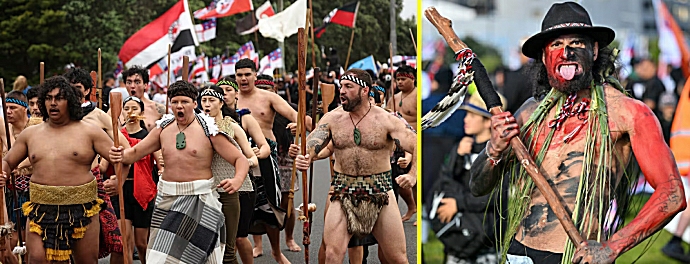
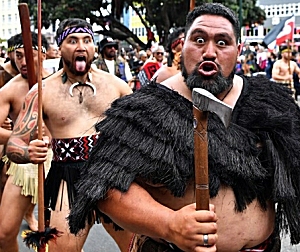
Last month, November 2024, New Zealand witnessed widespread protests and a 1,000 km 9-day march (three images above), comprised mainly of Maori, that culminated in some 40,000+ converging on Parliament. Inside an MP from the opposition Maori Party, Hana-Rawhiti Maipi-Clarke, then defiantly ripped up a copy of the If you haven't heard, the protests and the bill focused on something that has plagued many countries for centuries — racism and how everyone should be treated before the law. Lest you think that the bill was somehow opposed to that noble notion of racial equality, that it was some Trumpesque legislation trying to hold back racial reforms, and that's why the natives were justifiably restless, we must explain that it was actually pushing for equality and the Maori protesters were, surprisingly, vocally opposed to Maori receiving equal treatment before the law. No doubt you're also surprised, why would anyone not want to be treated as an equal, especially those of a minority group, and a people of colour? We should note that NZ society already tries to ensure everyone is treated equally before the law, including Maori obviously, but apparently this requirement for equal treatment is not written specifically into our law books. If NZ is ever sensible enough to adopt a written constitution we feel that stating that 'Everyone is equal before the law' should be one of its core statements. But until that happens, a bill that proposes a law that states exactly that would be a good start. After all, who wants to belong to a group that isn't treated equally to everyone else? Well ... quite a few irate Maori it seems. So, what is the 'Treaty Principles Bill' about? Well, the treaty it refers to is the Treaty of Waitangi that was signed between between Maori and the British Crown way back when Queen Victoria was a mere 20 years old and had been queen for just over two years. The principles this bill refers to were those contained in the treaty. Spoiler alert: there were none. Wait ... what? Even though mainstream media suggests that, opinion wise, most everyone supports these furious Maori protesters in their opposition to the proposed bill, perhaps we should first note that a TV3 News item mentioned that an informal survey revealed that 53% of people didn't understand the 'Treaty Principles Bill', and we'd suspect that the real number is likely much higher, meaning that the majority of people opposing the bill likely do so from ignorance. Their stance is based on opinions rather than facts. We base this suspicion on untold (and quite unrelated) discussions we've had with people over the years who said they had a good understanding of some issue they were trying to defend, be it religion, alien abductions, psychic mediums, chemtrails, energy healing, climate change denial, creationism or anti-vaccine arguments, but it quickly became apparent that most were woefully ignorant about the topic under discussion. These people confused a good understanding of a contentious topic with strong feelings about the topic. Essentially most were just regurgitating some simplistic sound-bites that their priest, homeopath, hairdresser or astrologer had told them, with none having read any of the books or arguments that expressed opposing views or had the word 'scientific' in the title. For example, I've lost count of the number of Christians and non-believers who have argued that Jesus the man was a real person, even if Jesus the god may not have been, and yet not one were familiar with the evidence that Jesus the man likely didn't exist, and none were prepared to read about it. They had made up their mind based on what the Church and (a religiously informed) society had told them, and nothing as flimsy as evidence would make them reconsider their stance. So even though roughly half the people say they do understand the Treaty Principles Bill, we suspect most will actually know little about it, and won't have even read it. Just as most Christians don't know that their Gospels weren't written by Matthew, Mark, Luke or John, and most conspiracy theorists claiming the moon landing was a hoax have no idea how many times we went to the moon or even how far away it is, and those arguing against evolution mistakenly insist that it says humans evolved from monkeys, most people will likely be against the Treaty Principles Bill for the weakest of reasons, reasons that are quite possibly bogus. They embrace vociferous opinions overheard at the pub rather than well reasoned arguments. Most, dare we say it, will have taken a stance based solely on race; it's all emotion combined with minimal thinking. In the TV3 News item we mentioned above journalist Lloyd Burr attempted a brief explanation of the bill, which apparently was a TV version of an article he wrote for Stuff entitled 'Explained: The Treaty Principles Bill' (which goes into a little more detail). Here are the highlights from the TV version: "The English version [of the Treaty of Waitangi] says Maori 'cede the sovereignty of New Zealand to Britain', but the Maori version uses the word 'kawangatanga' which means governance, not sovereignty. Maori thought they would still have control over their own affairs. The English version says Maori have 'undisturbed possession of properties', whereas the Maori version says 'tino rangatiratanga' [of] 'taonga', which means the 'chieftainship and full authority' over 'all treasured things', which aren't always tangible. So what are the treaty principles, well they weren't mentioned in law until 1975 ... so since then principles have been defined by judges and academics, politicians, bureaucrats and lawyers, and they're still a living, morphing, dynamic set of principles.Before we go further, we should note that while many will say that David Seymour (who looks and sounds whiter than Snow White) simply espouses a racist European mindset and that clearly explains the motivation for his bill. However he also has Maori ancestry, so according to Maori logic he is a Maori — a Maori calling for reform. OK, moving on. It's important to reiterate that this bill (were it to be adopted) wouldn't rewrite the Treaty of Waitangi, and that the original treaty made no mention of any treaty principles. To claim that 'redefining the principles is actually rewriting the treaty' is nonsense since no treaty principles were defined in the treaty, and clearly you can't change the wording of a definition that never existed. However the government and the judiciary have, nevertheless, been using "treaty principles" for decades to consider Maori compensation claims for historical injustices and to make new laws. What this means is that the laws and guidelines that are currently termed treaty principles are modern interpretations drawn up by 'judges and academics, politicians, bureaucrats and lawyers' based merely on what they feel was 'the spirit of the treaty'. If anyone should be accused of 'rewriting the treaty' it should be these modern day judges and academics etc who have taken it upon themselves to try and interpret what the treaty principles would have been had Queen Victoria's representatives thought to include any. The modern thoughts on what treaty principles may be derived on a reading of the treaty are not set in stone and as noted above are 'a living, morphing, dynamic set of principles'. That's apparently why no articles or TV news items bother to explain what the 'current' treaty principles are and exactly how they conflict with those in the proposed bill, and how these changes would be highly detrimental to Maori and advantageous to non-Maori. These 'current' treaty principles are clearly nebulous and complex and are derived piecemeal from untold legal, academic, political and bureaucratic sources as required, and is why no one is showing them side-by-side with those proposed in the bill for comparison. One opposition MP even suggested something like a conspiracy theory was afoot. In 'The Guardian', an article reported that, 'Labour leader Chris Hipkins ... said the bill was "based on a mythology" that Maori have special privilege. By nearly every metric, Maori fare worse than non-Maori, be it life expectancy, house ownership, health and education outcomes, or income'.Being a politician, Hipkins no doubt deliberately neglected to mention that Maori also fare far worse in other metrics, like membership of criminal gangs and the prison population. Hipkins is arguing that the bill was designed deliberately to take special privileges away from Maori, privileges that he asserts don't exist, and can't exist because if they did Maori wouldn't be failing in life. However the fact that many Maori struggle in life doesn't automatically invalidate the special privilege claim, especially since he refuses to disclose what that privilege is alleged to be. Might it be the special privilege that Maori have to collect any amount of valuable greenstone from any location (for carving jewellery and traditional clubs) whereas non-Maori can only fossick for small amounts on selected beaches, or the special privilege to take the bones of dead whales (again for carving into jewellery) that non-Maori don't have, or the special privilege that Maori (specifically Rakiura Maori) have to harvest muttonbirds that non-Maori don't have, or the special privilege that Maori have to join the Maori All Blacks that non-Maori don't have, etc, etc? Whether one agrees with them or not, these are all special privileges that Maori have, and yet simply having these special privileges clearly doesn't guarantee them a better life. It's claimed that merely being white is a privilege, and yet our prisons contain a lot of white guys too. You can have some form of privilege, compared to someone else, and still be a failure. But for the moment let's agree with Hipkens, Maori don't have special privilege, and therefore the bill won't and can't take this 'special privilege' from them by making them legally equal with non-Maori. So if Maori are not harmed by the bill, and their rights are not eroded, and if the bill merely puts into law what Hipkins asserts is already the case, why oppose it on the grounds that it is somehow harming Maori? What principle in the bill does Hipkins think would cause Maori to fare worse than they are now? This is just another opponent of the bill criticising it but refusing to say why, but unlike the silence from Maori, opposition party politicians like Hipkins simply want to cosy up to potential voters for the next election. They will oppose government policies no matter what they propose, that role is in their name and job description as an opposition party. The reality is that this linking of some special privilege with life's outcomes is specious. Faring badly in life doesn't prove that you lacked some special privilege, just as the lack of a special privilege doesn't destine one to be a failure. Maori insist that the bill doesn't align with the treaty principles (principles that, again, the treaty didn't specifically mention), but won't reveal what those principles are so that we can discern the differences and their shortcomings. Maori must be comparing the bill's proposed principles with what they are arguing are the "real" treaty principles, how else could they detect a problem? So why don't they reveal the real treaty principles, and how they derived them from the treaty, so we can all see the problem and all get behind scrapping the bill? We can only assume their silence on the matter must be because they believe the modern (and no doubt obscure, vague and fluid) wording of the treaty principles is somehow preferable and more advantageous to Maori compared to the bill's wording. This silence extends to the articles and TV news items we've seen, since no critic of the bill says exactly how Maori will be disadvantaged and what rights they will lose, it's merely claimed that they will suffer. For example, a CNN article simply said the bill 'would erode indigenous rights and harm social cohesion', but didn't explain why. In an article in 'The Guardian' critics said the bill 'would weaken Maori rights, remove checks on the Crown and drive anti-Maori rhetoric', but likewise explained no further. The BBC reported that critics say the bill 'would be divisive and lead to the unravelling of much-needed protections for many Maori', but didn't say why this would happen. 'Al Jazeera' reported that Maori were 'marching against a bill they believe undermines the Treaty of Waitangi and limits Maori rights', but again didn't bother to detail how being deemed equal would 'limit Maori rights'. 'The Guardian' article mentioned Eru Kapa-Kingi, 'the man who led NZ's biggest Maori rights march', implying (falsely) that protest marches were being held because Maori rights in NZ needed to be improved to match those of non-Maori. Consider the 'Black Lives Matter' marches and the historic suffragette marches, people were marching to gain equal rights, not protesting because their government was trying to grant them equality, which is closer to what these Maori rights marches were, Maori refusing equality. It seems all news outlets received the same media release, that the bill would harm Maori rights, the clear implication being that they would end up with less rights than non-Maori, ie the racist white colonialists, and no journalist thought to follow up and ask how a bill legalising equality would cause this eroding of rights. When articles both locally and globally continually reference a government threatening indigenous rights and Maori rights, how can they not fail to give the false impression that a racist government is trying to turn back the clock on race relations, recreating a society where one race has more rights than another? So in this regard we think reporting on this bill has been very misleading, with media focusing on the Us vs. Them and Good vs. Evil angle of the story, and when you're looking for a story that will go viral, what could be better than video of angry natives doing a war dance in the stuffy halls of parliament? But what does it really mean for Maori to criticise a bill because it 'limits Maori rights' and 'would weaken Maori rights', remembering that the bill says Maori and non-Maori would have equal rights (and effectively already do)? If by becoming legally equal with non-Maori, thanks to the bill, it's argued that Maori rights will have been limited or weakened then that must mean that Maori currently have more rights than non-Maori. If on the other hand Maori already have equal rights to non-Maori (as they do), or did somehow currently have less rights, then the bill would either maintain those equal rights or strengthen them, bringing them up to equality level. So again, since Maori are arguing that an equality bill 'would weaken Maori rights', this argument only makes sense if Maori rights currently surpass those of non-Maori. This is what needs explaining. Rather than just saying the bill 'would weaken Maori rights', explain how this arises from a bill saying that 'Everyone is equal before the law'. Or is it, again, that Maori don't want some privilege they hold, thanks to the current treaty principles, to be weakened? But the guidelines that are currently termed treaty principles have changed and can and will continue to be modified if need be, so the bill's goal to actually summarise and codify the treaty principles into law should help the people on the Waitangi Tribunal (the authority that considers treaty breaches) who have been playing around with the treaty principles for decades. If the (nonelected) Tribunal can interpret the treaty documents and draft treaty principles (as they see them) that are legally binding if accepted by the government then it's rather arrogant of people to say that should anyone else (say, a democratically elected government) attempt to do the same then they are rewriting the treaty, whereas the Tribunal isn't when it does it. To us this seems to suggest that Maori like the current version of 'fuzzy' and 'fluid' treaty principles but not the treaty principles proposed in the bill, implying that they will somehow lose rights were it adopted. But on reading the bill, how could any person complain about or criticise its aim unless they believed the current law (actually just a fluid interpretation by the Tribunal) gave their group rights and privileges that others didn't have, and being redefined as merely 'equal' would be a backward step for Maori? To us Principle 3 is the real crux of this treaty principles bill: Everyone is equal before the law. Who but a white supremacist or a brown supremacist could argue with that? Principle 1 that the government has full power to govern is only common sense in a democracy (and remember that Maori are already legally part of government), and Principle 2 giving Maori special rights if it's been agreed to in a treaty claim is just since Maori did suffer injustices around loss of land etc. Again, like the 'Everyone is equal before the law' principle, what good arguments could one make to oppose those three principles becoming part of NZ law? Maybe those arguments exist, but why aren't Maori making them? Of all the media coverage we've seen around the protest marches to Wellington and the angry outbursts in parliament (and bloody hell, are we sick of seeing video replays of that haka), it's been consistently noted that the bill will not pass since it doesn't have the support of all parties in the coalition government. The bill will be debated for 6 months with public submissions and then it will fail to proceed further. Even though Maori and the media insist that the public is overwhelmingly against the bill (although we're not aware of any official poll showing that), apparently Maori are still terrified that politicians, perhaps swayed by a public who might suddenly decide after hearing the debates that it's not such a bad idea after all, will renege on their promise and let the bill proceed. But here's the thing, what we haven't heard the media mention at all is that simply passing the bill wouldn't turn its proposed treaty principles into law. Have they not actually read it? To become law the bill states that a referendum must first be held and a majority of voters must support it. It's a little something called ... umm ... oh yeah ... democracy. It doesn't matter if a political party has proposed a bill on treaty principles, in this case the NZ public get the final say on whether it comes into force. To us this outcry by Maori that the government might back down on their promise to ditch the bill hides their real fear that were the public given a democratic voice in a referendum then they might actually opt for ... what was it again, oh yeah ... equal rights for all. [UPDATE: The deadline has since passed and the bill was dropped as promised and proceeded no further.] We're all equal, but some of us are more equal than others
Let's look a little closer at this surprising scenario where Maori appear to be opposed to everyone receiving equal treatment before the law, where they're willing to fight for inequality to remain. Does it really make sense that any group would do this? Yes it does, and such groups have been fighting to maintain inequality for millennia. Of course whenever racial (and indeed social) equality is being discussed, most people picture a disadvantaged minority, often people of colour (POC), that are striving to receive treatment equal to the majority group in society, who are usually the ruling class and often white. So naturally these disadvantaged people want, and in our view, deserve equality. But in many countries worldwide there are quite a few people in various groups in society that currently have a life of privilege, and for them any move towards equality is seen as a negative step, a move that would see them lose their elite status, and make them someone that has no more rights than a lowly commoner. These are groups that believe they are above us mere plebs based on such things as their wealth, ancestry, race, positions of power in government or corporations, education etc. Throughout history people such as kings and queens, dictators, governors, village chiefs, members of the aristocracy and ruling elite, wealthy land owners and religious leaders, all saw themselves as superior to various other groups in society, and of course for a shameful part of history groups with white skin saw themselves as superior to all those with other skin colours and ethnicities, and their laws and traditions reflected and maintained this inequality. The privileges one enjoyed were based on a strict hierarchy, which in turn was based on such things as ancestry, race, wealth and power, there was no equality between groups. And in modern times, think of people like Donald Trump, Vladimir Putin, King Charles, Kim Jong Un, Elon Musk, Mark Zuckerberg, Kim Kardashian, Pope Francis etc. Can you imagine any of them treating you like an equal and working to ensure you get to enjoy the same privileges in life that they currently have? Clearly there are many in the world's currently privileged groups that do not want equality, they desperately want to maintain their superiority over the rest of us. The most obvious and egregious example would be white supremacist groups, such as the Ku Klux Klan in the US, So when we see someone opposing a call for equality for all, we immediately wonder what privilege do they currently have that they don't want the rest of us to have. Clearly Maori are not opposing the call for everyone to be equal before the law because they are afraid of gaining some new rights and privileges, so is it because they believe equality would cause them to lose some major privilege that only they currently have? A privilege based solely on race? Where are we headed as a country when some people don't want equality? When we think of the 'Black Lives Matter' movement that (rightly) created huge protests in the USA a while back, and we then look at NZ society today, we're not too optimistic about a colour blind future for us in NZ. Which surprises us considering where we came from. The United States, which are anything but united, is struggling to create racial equality from a not too distant history of slavery, then enforced segregation and still ongoing gross inequality, whereas we had a society that was approaching racial equality and unity (legally at least, if not always socially) but are now struggling to retain it. Why is the US and NZ moving in opposite directions when it comes to race relations, with the US generally seeking to unite and NZ seeking separation? Is separation the answer? Rather than striving for equality, uniting people of different races and making racial differences a non-issue, should we instead reverse tack and highlight racial differences, separate people into different groups based on skin colour and ethnicity, on who our ancestors were, and where they came from? Should we then provide different services and benefits based on which racial group one belongs to? Separate health, education and justice systems and a separate arm of government for each racial group, where the rights, entitlements and legal requirements one has in society rest solely on the racial group they have been allocated to? We're not just talking about racially segregated hospitals and law courts that both provide the same treatments and apply the same laws (but separately) for both Maori and non-Maori, we're referring to a Maori hospital choosing to offer traditional Maori healing, such as healing by spirits and natural herbs, as opposed to a hospital for non-Maori opting for MRI scanners and vaccines, and separate courts for Maori and non-Maori where some actions are legal in one but illegal in the other. Where what you can be cured of or get away with legally is based on your ethnicity. Would this separation make for a happy and flourishing society? The fact that it is thought that different racial groups require different services, for example a different health service due to their racial differences, different learning styles that require different schools, and where Maori and non-Maori have a different sense of what is just and unjust and therefore need their own unique justice system, means that what each group is entitled to would vary widely. This would not be a society where you chose the service you thought would best benefit you, you got the service your skin colour and ethnicity dictated. Clearly one health system would, say, offer more advanced treatments than the other, and one justice system would have laws that many felt were fairer than the other, but this is the nature of having different systems for different groups. If everyone simply got access to the best system available then there would only be one system and one group that comprised the whole of society, with no consideration as to race. But separation does allocate services and rights based on race, not need. No doubt one or two groups, those that were allocated a life of privilege, would be happy, but clearly those groups denied those same privileges would not be, and their discontent would surely impact on the privileged group, making their life less happy, so society overall would suffer.
And consider also that different systems providing different services for different groups would cost far more than one system for all. Different health, justice and education systems would require different training facilities for doctors, nurses, lawyers, judges, teachers, administrators etc all being taught quite different things, Maori things for one and non-Maori or "Western" things for the other. Everything from the physical buildings like hospitals and courtrooms to the people that worked in them would have to be duplicated. Different justice systems legislated by different governments would each require their own police force. Likewise each government would require its own military. NZ currently struggles to fund and manage our health, justice and education systems, to train and retain doctors, teachers and police, so what hope in hell would we have in trying to add a duplicate setup alongside the current systems? The cost would be astronomical and obviously impractical. How would that even be attempted? If Maori operated a separate arm of government, which would surely include their own taxation system, then non-Maori taxpayers would rightly demand that their taxes not be used to fund Maori systems that they could not benefit from, just as Kiwis currently refuse to allow our taxes to pay for services or infrastructure in other governments, like hospitals in Australia or schools in the US. The reduced tax take for both the Maori and non-Maori branches of government couldn't hope to provide services similar to what we currently have. Couple this with the fact that Maori only make up 17% of the population, so a small tax pool to drawn from, and that many Maori are on low wages or unemployed, meaning they are paying little tax or none at all and are receiving government benefits, so are actually draining the system. Where is the money going to come from? With the larger population and tax take, and not having to pay for Maori services, non-Maori services could We have clear examples of separation at work around the world. Consider the likes of Israel and Palestine, China and Taiwan, Russia and Ukraine, North and South Korea, the civil wars in Sudan and Syria, or in the recent past, North and South Vietnam, Iran and Iraq, and the racial segregation in America prior to and after their civil war, right into the mid-20th century. Or what about the recent bloody conflict in Northern Ireland that kept the Irish nationalists (mostly Catholics) and British loyalists (mostly Protestants) apart, and of course apartheid in South Africa, the brutally enforced legal separation of whites and blacks? Those places went to war, are at war or are threatening war over an inability to coexist with their fellow humans whom they share land or borders with. This refusal to collaborate and compromise and unite in peace has resulted in untold death and suffering, much of it still ongoing, obviously in places like Gaza and Ukraine, but also in deaths and injuries in the likes of Vietnam and Afghanistan due to thousands of unexploded ordnance (bombs, shells, mines), starvation and deprivation in North Korea, and racial violence in the US. And of course there are many, many more contemporary and historical examples where this unwillingness of one group of people to share a place with another group that thought or acted or looked a little different resulted in violent persecution and even genocide. Such as the burning of Christian heretics and the murder of Jews. These animosities resulted in the formulating of laws that favoured one group and discriminated against the rest, in short, in maintaining the separation between groups. There is no example that comes to mind where this enforced separation has been to the benefit of all involved, not even a majority in any society. Look at the royal families and their supporting aristocracy in Britain and Europe over the centuries, those privileged groups made up a mere handful of a country's population, meaning most people worn rags and survived on bread and water while the privileged elite in their castles and mansions worn silk and gold and dined on venison, pheasant and fine wines. And as we've already mentioned, these lavish and decadent lifestyles are repeated today by the likes of Trump, King Charles, Zuckerberg and Kim Kardashian, snobby, arrogant assholes who make up the 1% and believe they have the right to live in the lap of luxury, wasting millions on frivolous toys, while dictating how the rest of us should behave in order to please them. The separation of the likes of tigers and people for our safety makes sense because an understanding clearly can't be reached due to us being different species, but separating people for their own benefit doesn't make sense because we are the same species, the same 'race' even (on which, more below), and we are clearly capable of communicating and empathising with each other in order to reach an understanding of peaceful cooperation, even where differences in views and appearances exist. You don't have to be a rocket scientist to understand that societies are far better off when they unite and work together, where everyone is treated equally and shares equally in the resources available and the progress that is made. Rather than use the term separation, in recent years many Maori have preferred to use the euphemism 'co-governance', which Wikipedia says, 'consists of various negotiated arrangements where Maori people and the Crown share decision-making, or Maori exercise a form of self-determination through a devolution of state power'.The Maori argument is that since the treaty was signed between the Crown and Maori, then Maori and the Crown should now share decision-making, which is clear separation in a political and democratic sense, where people claiming Maori descent get half the votes in every political decision and the Crown the other half, since that's what 'share' in this context means, equal parts. The problem here is that in relation to NZ today the term 'the Crown' legally refers to 'the executive branch of government, which includes the Prime Minister, Cabinet, and government departments', whereas when the Treaty of Waitangi was signed the NZ government didn't exist, and back then 'the Crown' referred to the British monarch. The treaty was a contract negotiated between the British government (representing monarch Queen Victoria) and the chiefs of various Maori tribes, not between Maori and a non-existent NZ government. The governing body that the treaty between Maori and the British brought about was the NZ government, but the current NZ government, what is now sometimes confusingly referred to as 'the Crown', obviously played no part in the treaty negotiations. The NZ government that the treaty created combined both the British and Maori into one governing body; the NZ government or 'Crown' is not just a body that only represents British interests and where Maori remain outside. Maori keep referring to 'the Crown' in an historic sense, as if the the current NZ government is just a mouthpiece for the British monarch, and being quite separate from the British, ie 'the Crown', Maori therefore see themselves as remaining quite separate from the NZ government. That is quite wrong, as Maori are just as much part of the NZ government — 'the Crown' — and fully represented by it as are New Zealanders of British, Chinese or French descent. Back in 2008 we criticised this push for Maori sovereignty and their demand to fly the Maori flag on government buildings, where the argument was that as one of the treaty partners Maori have the right to fly their flag alongside the NZ flag. But if this were true then we shouldn't be flying the NZ flag at all. Instead the Maori flag should fly alongside the British Union Jack — the flag of the Crown — the other treaty partner. The NZ flag actually symbolises the union of two cultures, of the two treaty partners. The argument also ignores the fact that Maori had no flag prior to the arrival of Europeans, and still don't have one they can all agree on. Maori only adopted flags (and a Maori king) to copy British customs. But Maori continue to highlight what they see as a clear, legal separation between them and the NZ government, who they keep thinking of as still representing the British Crown. Even though the treaty merged Maori and British settlers into one legal entity, where the vision was that both would be represented equally by the newly formed NZ government made up of both Maori and British politicians, many Maori still see themselves as outside a government that is just a front for the British monarchy. For example, discussing the the 'Treaty Principles Bill' above, it was noted above that 'opponents of the bill ... say ... it rewrites a contract without agreement from the other signatory 184 years after it was signed'. These Maori opponents believe the bill has been written by one of the treaty's signatories, the NZ government, ie the British Crown, and the 'other signatory' they're referring to is Maori, specifically the Maori tribal chiefs, and as their descendants they believe they must now be consulted and reach an agreement on this new bill. They're arguing that simply being Maori should give them a special and privileged say on the bill. If this argument is valid (we don't believe it is), then let's remember that this was a treaty, so why is agreement not being sought from the 'other signatory', the British crown? Why are the NZ descendants of the British signatories not being consulted and their agreement sought? Why should Maori descendants get a voice and a vote but not the British descendants? And please don't say the government represents the voice of the British descendants. However many NZers do believe this, especially Maori, viewing the current NZ government as representing the British crown. Again, they think of NZ as still being a crown colony (and still treat its kings, queens, princes and princesses like ... well ... privileged royalty) but forget that NZ has gained full independence from Britain. The reality is that the NZ government represents (and is comprised of) all NZers, with no regard to their ancestry. The government is not made up solely of Europeans who can trace their bloodlines back to the British who signed the treaty, and can therefore legitimately continue to represent the British crown. When Maori have a gripe with the government they have to stop claiming that they are still dealing with Queen Victoria's representatives. They are not, the British crown and its control of its far flung colony is long gone, the entity that now controls NZ is solely comprised of Kiwis (of various ancestries, including British and Maori), it is not a government full of loyal Brits with Maori protesting and waving their spears outside the gates (oh wait ... some Maori are still doing that). The long term goal of the treaty was that neither the British nor Maori would rule the other, that they would both collaborate in forming a government and running NZ. To this end four Maori were elected to parliament in 1868 as MPs, and one in his opening speech 'urged the government to enact wise laws to promote good, and for Maori and Pakeha to work together'. As soon as Maori MPs joined with British MPs the NZ government became a joint venture, neither crown nor Maori but a government representing the interests of both. So if Maori, as descendants of the original signatories, are correct in saying that as such they must still be consulted regarding government decisions, then the same must apply to British descendants of the original signatories. It can't be co-governance if only Maori, only one side of the treaty, has the option to be heard. Of course this would create a major problem if implemented. Were all government decisions debated and decided upon solely by the descendants of the original signatories this would alienate the majority of Kiwis who are not linked to the original signatories, for example, someone from China, and therefore would get no say in the running of their country. NZ would cease to be a democracy and would become an oligarchy, where power rests in the hands of a small, privileged class; the descendants of the original Maori and British signatories. We'd argue that the majority of Kiwis don't want this (including Maori if they thought about it), and instead want the status quo, where a democratic government is elected from a pool of people with diverse ancestries (European, Maori, Pacific Islander, Chinese, Indian etc) and work for the good of all NZers, irrespective of where their great-grandparents were born. But this is not what Maori activists and opponents to the bill want, they see the Crown, ie the NZ government, as a governing body that only represents NZers that are not Maori. Maori believe that as a treaty partner standing alongside the Crown, decisions affecting the country can only be made after Maori and the Crown consult with each other and reach an agreement, meaning only in unison can the country be governed as per the treaty. We believe this is far removed from what the treaty envisioned. It promised equality between Maori and British settlers, that each citizen would get an equal say in how the country should run, meaning each would get a single vote and the same rights under the law and the right to petition the government or join it as an MP. Of course initially only some people could vote, like male land owners, and women had far less rights than men, but this was the case worldwide, it had nothing to do with the treaty, and eventually things improved for everyone, NZ even became the first country in the world to grant women the vote. So yes, there were a few hiccups along the way but eventually the treaty vision was achieved, which was that each person of Maori or British descent gets a say in governing the country, and is treated equally under the law. It did not say that the country would be governed by one group representing Maori and another representing the British, and they would both go head-to-head with each other when negotiating government policy and try to reach some sort of consensus. That would be somewhat like a coalition government, but not quite, as no one would get to elect the members of the Maori group, meaning the Maori group would always be in government by default, whether the majority of NZ's citizens wanted them in power or not. The public would only get a say in electing members of the "British" group, what we normally call the NZ government, and what Maori call 'the Crown'. Any NZ citizen of any ethnic descent, even Maori, can campaign to be part of 'the Crown' group, but only Maori can be part of the Maori group. The majority of NZ citizens would not be getting fair and equal representation in the running of their country, since they could only vote for one half of those that made up the government, unlike Maori who could join and support either group, and who would of course, in a wise strategic move, stack the 'the Crown' group with Maori MPs to further increase their political influence. Rather than it being one person one vote, it would be one group one vote, but because each group is not equal it would be unfair representation. Currently NZ's political system is a democracy where all adult citizens, regardless of ethnicity, get a single vote (well, two actually, but the point is that no one gets more votes — more influence — than anyone else). Every citizen, no matter whether they have English, Maori or Chinese ancestry, gets an equal say in electing our government, the entire government, who then run the country on our behalf for a term of three years. Currently the NZ government represents every NZ citizen, but in the co-governance proposal the Crown would represent around 83% of the population (the non-Maori portion) but would receive only 50% of the vote in any decision making, while Maori would only represent around 17% of the population (according to 2024 Stats NZ figures) but would claim the remaining 50% of the vote. Maori would have disproportionate influence on every decision made. That is not democracy. Maori studies Professor Margaret Mutu of Auckland University describes co-governance as Maori 'making decisions about their own lives, the government making its own decisions about its people's lives, and both parties meeting to make decisions on matters that relate to us both'.Again, this is clear separation, where Maori will have complete control with no government interference over 'decisions about their own lives', akin to how the USA or China can't dictate what decisions the NZ government makes concerning Kiwi lives. Referring to what she calls 'the government', meaning the governing authority that represents NZers that are non-Maori, note how Mutu talks of how it would be limited to only 'making its own decisions about its people's lives', where again 'its people' refers to non-Maori. Mutu clearly doesn't see Maori as being a part of NZ's 'government'. And of course the statement about 'both parties meeting to make decisions on matters that relate to us both' is extremely vague. Who gets to decide when both groups should work together and when one group should just mind its own bloody business? Consider an extreme example, Maori grant themselves the right to openly carry weapons as was their tradition and are even considering restarting tribal warfare to give their youth traditional warrior training. The government complains (ie the branch representing non-Maori), saying its citizens feel threatened by this shown of violence, but Maori dismiss these concerns saying Maori have a right to their traditions. Even parties in real coalition governments often struggle to reach consensus, why should we expect that unity will be better achieved by having two separate governments with different agendas trying to govern the same county? Ask Israel and Palestine or Russia and Ukraine or even America's Republicans and Democrats how well their negotiations are going on matters that relate to them both. Since some Maori are indeed pushing for actual separatism, for separate branches of government, different laws and separate schools and health facilities for Maori, if that was the true intention of the treaty (at least as they interpret it) then why do we not see Maori insisting that white/non-Maori versions of the health, justice, education systems also be established to keep things truly separate? If Maori believe they can't work in with non-Maori, that combined health, justice, education, political systems etc cannot deliver as good an outcome for Maori as standalone Maori systems can, then why aren't they pushing for true separation, for racial segregation? Why aren't we seeing a move to a society like existed in both the US and South Africa for much of the 20th century? What's next for us, separate beaches, restaurants and movie theatres? Oh wait, there was that controversy back in 2004 where Maori tried to insist that they owned NZ's foreshore and seabed and they should control who got to access to our beaches ... sorry, their beaches ... since when it comes to enjoying sand and surf, apparently Kiwis need to first get permission (on a case by case basis) from local Maori elders. Thankfully the government at the time legislated that our country's beaches were not just for the natives. UPDATE: In August 2025 the government considered making some changes that would strengthen the foreshore and seabed legislation, and Chris Finlayson, the former Treaty Negotiations Minister & Attorney General that was involved in the original legislation, appeared on a TV3 News interview angrily condemning these possible changes, saying, 'There is no need for the legislation ... and it's changing the rules of engagement considerably'. Of course old white guys like Finlayson made that same argument over a century ago when women tried to get the vote, saying there was no need to allow women the vote and doing so would change the rules of engagement considerably. Rejecting new legislation simply because it changes the rules is not a good argument, changes should be made if the current rules are discriminatory or if obvious improvements can be made for the benefit of all. Finlayson argued that his treaty legislation should remain in force because he helped draft it, meaning, as he said, 'I know more about it than them', ie the current government. He believes that being part of a group that changed some legislation years ago apparently gave him more legal expertise than anyone in today's government could possibly have. However by the same argument the lawyers and politicians that drafted the original treaty could argue that they knew more about it and their intentions than Finlayson, so he had no right to make his changes. But of course this is a bogus argument, just because you were involved in drafting some specific legislation many years ago, for example, laws that said women can't vote or contraception is illegal, doesn't mean that specific legislation is still suitable for modern life, and that it didn't in fact discriminate against some group. Just think how unjust society would be today if Finlayson's argument that we shouldn't be changing old laws was followed, that the old white guys that made those laws knew more about the issue than us and knew what they were doing. So back off! We'd still have slavery. Unfortunately contentious political issues like this have in recent years seen both of NZ's major political parties and several minor parties all speaking more positively of co-governance, which has only emboldened moves towards separatism. Oh joy! So yes, our feeling is that NZ is going backwards in regards to race relations between Maori and the rest of us. To explain our take on NZ race relations perhaps we should quickly look at some history. Scientific evidence indicates that Polynesians were the first people to discover and settle the country we now call New Zealand sometime between 1250 and 1300 CE. These Polynesians, because of their isolation, later became the culture we now call Maori, in the same way that Europeans who settled the "New World" became Americans due to their new country causing changes in their lifestyle and culture, and it should also be noted that it was Maori from NZ that later became known as Moriori when they later travelled to and settled the Chatham Islands, 800 kms east of NZ, around 1500 CE. The first European to sight NZ was Dutch explorer Abel Tasman in 1642 CE, who was driven off by Maori, and the name New Zealand comes from the name a Dutch mapmaker put on his map — 'Nieuw Zeeland' (after the Dutch province of Zeeland). Next was Captain James Cook in 1769 CE, and while there was some settlement by Europeans in the 1820s, immigration schemes really only began in 1840 following the signing of the Treaty of Waitangi between the native Maori chiefs and the recently arrived British. New Zealand then became a British colony. This treaty — rather than a violent overthrow with an unconditional surrender as happened in many other countries historically — led to the creation of a new country — New Zealand — where both Maori and British settlers were granted equal rights, and the country would be shared, not split in two with Maori and the British each controlling their own region. The treaty's vision was that a new country would be 'built on working together', where Maori and British settlers would become 'one people'. It's also interesting to consider the name Maori now use to refer to NZ — Aotearoa — and their claim that it's NZ's traditional name. That isn't actually true. In this article 'Aotearoa: What's in a name?', Professor Kerry Howe explains that 'Maori appear not to have had a name for what is now called New Zealand', 'Aotearoa, it is widely assumed, is the original 'indigenous name' for New Zealand. It is certainly the 'modern' name favoured by many Maori and others. But our current common use and understanding of the name was probably not in existence before Western contact'.Wikipedia notes that, 'The use of Aotearoa to refer to the whole country is a post-colonial custom ... In the pre-European era, Maori did not have a collective name for the two islands ... As late as the 1890s the name ... was originally used by Maori in reference only to the North Island ... [and where] Te Waipounamu means South Island'.Even the name 'Maori' is not traditional nor ancient since, like many other isolated cultures in past eras, they didn't need a name for themselves when there was only them, it was only with the arrival of Europeans that names for us and them (European and Maori) were needed. In the book 'Digging Up the Past: New Zealand's Archaeological History' (1997) by Michael Trotter and Beverley McCulloch, they note that, 'The term Maori, to describe a native New Zealander, did not come into use until the late 1830s'.We should also mention that 'pakeha' is the Maori word used to describe a New Zealander of white European descent. Where the word comes from is not definitively known, but quite possibly from the Maori word 'pakepakeha' which referred to mythical, light-skinned beings who were said to inhabit the forests and mountains, and 'Some sources also suggest it could be related to an older term for sea gods'. We are not a fan of blindly referring to all non-Maori as 'pakeha' since these days many New Zealanders are not white nor of European descent. Labelling all New Zealanders who are not Maori as pakeha is like labelling every car that isn't a Ferrari as a Toyota. The terms 'native' and 'indigenous' also need clarifying, names Maori continually apply to themselves — and only them — in order to imply that only natives have a genuine right to be here, everyone else is a visitor or an invader. However my dictionary considers the words 'native', 'indigenous' and 'aboriginal' as synonyms, words that have essentially the same meaning, and states: 'Native implies birth or origin in the specified place.I am not Maori (at least not that I'm aware of), but I was born in NZ, as were my parents and grandparents, so by definition I am a native New Zealander. To be a native of a specified place does not carry the condition that your distant ancestors must have been the first to settle that place. The label 'indigenous' defines itself in terms of being a native, of not coming from elsewhere, so again, by definition I am an indigenous New Zealander. The term 'aboriginal' is the one that best describes what Maori mean when they call themselves natives, but it is seldom used, probably because they think it only refers to native Australians. However Maori can not call themselves aboriginal in the sense that they have been in NZ 'from the beginning', since we have already established that they arrived from elsewhere; even their own origin myths have them voyaging the sea and discovering NZ (just like the Europeans). But they claim to have been the first humans here, so they can use aboriginal to describe their ancestors as 'the earliest known inhabitants of a place'. However simply being first to set foot in some place does not guarantee that you or your descendants will always retain ownership. Probably every country in the world has a history of untold invaders, conquerors, colonisers and "liberators" arriving on their border and claiming to be the new owners. Many newcomers to some strange land violently and unjustly oppressed and slaughtered the land's existing tenants, just read the Bible for example, or some early American or Australian history, and modern examples like Ukraine and Gaza demonstrate that even today being there first counts for nothing to some people. Even America's President Trump is currently plotting to take over the Panama Canal and Greenland. Of course the Treaty of Waitangi is not a modern document covered by modern international laws and more informed ethics, this agreement between Maori and the British happened almost two centuries ago. And as we've argued elsewhere, it's just foolish for any group to think that they can force a reset on some piece of land where they believe, rightly or wrongly, that some injustice occurred in historical times. The people that currently dominate most every country of the world, such as the USA, Britain, Greece, China, Australia, South Africa, Japan, Egypt, Israel, Russia, Spain etc, were not that land's original inhabitants, they all displaced, slaughtered or merged with the land's aboriginals centuries or millennia ago. There can be no turning back of the clock where land is returned to previous owners of centuries ago; New York city is never going to be handed back to Native Americans, nor London to the Celts. We should acknowledge past injustices and work to ensure they don't happen in modern times, but we can't rectify past mistakes. All we can do is look at the current arrangements and try to make social improvements to ensure every citizen in every community is leading the best life possible. Forget about what their distant ancestors might have had in regard to wealth and land and power, the past cannot be retrieved, and even if it could somehow, for them to suddenly be given this land and power in society would mean that those who currently have it would have to relinquish it. The aggrieved would become the privileged elite and the privileged elite would become the aggrieved, and the battle for justice would start anew. Surely it is far better to work towards creating equality for all and a more even distribution of wealth, especially since this direct swapping of position in society is never going to happen. Yet many Maori spend their days pining or agitating for a fantasy world where they own all the land in the country, one now called Aotearoa, where Maori is the only official language, where Maori are the dominant power in government, where teenagers get ugly, disfiguring tattoos on their 16th birthday rather than a car or fake boobs, where Maori 'knowledge' (ie ancient myth and superstition) is taught in science classes and promoted in hospitals, where Maori don't have to register their vehicles, obtain a driver's licence, dog licence or fishing licence, where Maori religious rituals have replaced Christian rituals and are performed at all important public events (oh wait ... that already happens), where in essence the colonial past never happened and Maori have remained as tribal chiefs over their stone-age villages (but have retained their high-speed Internet of course). Rather than forlornly wish that this is how things had panned out, surely the only sensible and realistic option is to treat the past as past, as something that can't be changed, and work instead towards reducing the gaps between rich and poor and powerful and weak, regardless of one's ancestry. And again, I am not Maori, but I am, by definition, an indigenous and native New Zealander. So whatever rights Maori claim by being indigenous and native must also apply to me, and every other non-Maori that was born in NZ. I can't claim to be aboriginal but we've never heard anyone claim nor do we know of any law or argument that states that aboriginals have more rights than natives. And Maori can't really claim to be aboriginal either, they can merely claim that their distant ancestors were, and whatever rights they believe their distant ancestors may have had in terms of ownership and behaviour don't automatically transfer to them. If my distant ancestor in England in the 10th century possessed a castle and a vast estate, owned many slaves, and was gay, that doesn't mean I can now reclaim that land, enslave people or claim to part of the LGBQ community just because of that genetic connection with my ancestor. What happened in the distant past essentially happened to complete strangers and just as any crimes they may have committed long ago can't now be tied to us, even if we are distantly related, likewise any land and assets they may have once owned cannot now be reclaimed based solely on some remote, diluted blood relationship. Claiming to share genes with a distant ancestor doesn't give one the right to claim his land and booty as well. (And yes, it was always 'his' booty, since again, women, not being equal, couldn't own booty.) Racism 101 and the colour spectrum So, to recap, in our distant past a treaty was signed between Maori and the British with the hope that we would all become 'one people'. Did everything go smoothly? No it didn't, there were still unjustified land confiscations, nasty conflicts and bloody wars, with Maori undeniably suffering the most. But eventually, slowly, things got better. Having no history of slavery or enforced segregation to overcome likely helped, and with the treaty granting equal opportunity to everyone NZ finally became a country of New Zealanders, not of the British (or more generally Europeans) up front and Maori out the back. Or at least that's how it appeared to us growing up in modern NZ. An article from the BBC reporting on the treaty principles bill noted that 'New Zealand has long been lauded for upholding indigenous rights', and even Hana-Rawhiti Maipi-Clarke, the Maori Party MP that torn up the bill in Parliament, is supportive of the treaty while critical of the bill, and said that, 'The treaty unites us and our country is known for having a beautiful partnership that most indigenous countries don't have and let's not give it [the Bill] the power'. No doubt racism existed in the past (on both sides), just as there would have been some people persecuting homosexuals and atheists, but it wasn't obvious to us. In schools, on farms and in factories, in our sports teams, in our military, and in the pubs, Maori and European studied, worked, played and lived side by side. If you dug deep enough you surely would have found discrimination and problems in some places, but as a multicultural society we seemed to be doing pretty good compared to many other countries. Think of the many race riots that have happened in the US over the years or the number of black Americans shot by police for 'driving while black'. In the 1970s and '80s many NZers protested over apartheid in South Africa, arguing that blacks and whites should be treated equally in South African society, just as browns and whites were treated equally in NZ. Much of this debate in NZ was motivated by sport, NZ vs South Africa, since while Maoris were free to play in our national rugby team, blacks weren't allowed in the South African team. Back then we were all just Kiwis, not Maoris and Europeans, but from 1928 right through to the 1970s Maori players were forced to stay at home when the All Blacks played South Africa. South Africa eventually scrapped apartheid and everyone became South Africans, and yet since then NZ has moved from apparent racial unity to a weak form of apartheid, from everyone being New Zealanders to now where every official form or census you fill out demands you state what race you belong to; Maori, European, Chinese, Pacific Islander etc. And it's not just intellectual curiosity, your answer often dictates how much you pay or what services you're entitled to. We now have policies that imply that Maori are more deserving than others simply by being Maori, policies that ignore actual need and allocate solely on race. If that's not racism then we don't know what is! And some would agree, saying that with our support of policies that put need above race then clearly we don't know what racism is, and it is we who are being racist, which reminds us of a TV sitcom where a character was labelled a racist. She denied being a racist, but was promptly told she needed to look up the definition of racism since her exact response was, 'I'm not a racist, I drive a Prius' (a hybrid electric car made by Toyota). Obviously this was a joke to highlight that far too many people truly don't understand what racist means, and while taken to a silly level, it is none the less true. I remember back in 2004 when NZ politician Don Brash gave a speech about NZ civil rights and race relations that became infamous for him advocating that everyone should be treated equally, 'one rule for all', and that benefits and such should be allocated on 'need not race'. What stunned me was the angry reaction of many afterwards to the speech, with many, mainly Maori, calling Brash a racist. Over and over again, the insult was hurled. He was a racist for wanting everyone regardless of race to be treated equally. Did these morons not know what a racist was? Not even the media were prepared to set the record straight. Now, 20 years later, that insult, although it is still utterly bogus, is the one most often thrown when anyone questions allocations based on race: You're a racist! It just demonstrates ignorance on the part of the person that uses it, and reminds me of a skit where a British comedienne was discussing why the British voted for Brexit. She said, 'My friends keep saying, how could people be so stupid? And I'm like, have you met most people? Most people are idiots'. So true. Most people keep saying anyone who wants equality is a racist. That's like calling a virgin a serial rapist. Of course many do know exactly what racist means, and (as is especially prevalent in NZ today) use the word simply to silence people, as few people want to be labelled a racist. To counter this devious ploy I respond by asking them to define racist, which quickly exposes their deception or their ignorance. So before we go further, perhaps we should define what we believe racism means, since if you ask a dozen people you'll likely get 15 different answers. My dictionary defines racism as: 1. The belief that race accounts for differences in human character or ability and that a particular race is superior to others.An online Cambridge Academic Dictionary defines a racist as: 'a person who believes that some races are better than others, or who acts unfairly to someone becauseWhen we think of the bogus belief that 'a particular race is superior to others' and that this belief then leads to 'discrimination or prejudice based on race', the images that generally pop into our heads are that of white supremacists, especially heavily armed militias and bigoted cops in the USA, of the Ku Klux Klan (again in the US), and in NZ groups of skin heads with their Nazi tattoos wandering the streets or screaming their slogans at protests. The thing all those groups have in common is their fervent belief that the white race is superior to all others and their anger when they see people from other races being treated as equals, or even overhear so-called "Kiwis" speaking a foreign language in the supermarket. Of course not all racists are vocal (and often violent) white supremacists, the majority are silent members of society, too afraid to blatantly reveal their smouldering racism except around friends (like-minded white friends), which means that there are far more racists out there than you see on the TV news at Trump rallies. Another thing that usually unites white supremacists is Christianity and their love of a dead Jewish carpenter called Jesus, which is rather strange since many white supremacists are equally prejudiced against Jews. Like black and white races, they view Jews as yet another race (which they're not). Of course in fairness we should note that Muslims can be just as anti-Semitic, just as hateful of the Jews as Christians. It's something to do with an all-loving god who loves everyone but doesn't ... umm ... love everyone (We know it doesn't make sense, but that's religion for you). Of course there is diversity among people — different skin and hair colour, body shapes and sizes, genitals and sexuality, languages and cultural beliefs, religions, clothing styles etc — and people have, for centuries, been persecuted and discriminated against or privileged and rewarded depending on which of these differences they possessed. And obviously individuals can be superior or inferior in some measure, say height, sporting ability or intellect, when compared to one another, but none of those differences make one entire group of people naturally superior to all the other groups. It's quite stupid to say that an Englishman is superior to a Zulu (remember colonialism?), that brunettes are smarter than blondes (remember the 'dumb blondes' label?), or that men are superior to women (remember the patriarchy? ... oh wait, that's still with us), and yet many still ignorantly hold these biased views. And racist views of superiority based on skin colour still hold sway in many societies, even though there is clearly no justification for such views. Anyone that believes that their race is better than all others, more deserving than all others, and better suited to be in control of the inferior races is no different to the arrogant fools that believe their (invisible) god is better than the next person's god (also invisible). These notions of superior skin colour and gods are both derived from the quite bogus beliefs of primitive, superstitious people, and they should have disappeared with the burning of witches, virgin sacrifices and wooden clogs. It astounds us that people can be so racist, insisting that their race is superior, and yet they will all have met or at least be familiar with many, many individuals belonging to a race that they deem inferior that are far, far superior to them — more intelligent, better educated, better career, holding more power and authority, better looking, more athletic, wealthier etc. How does this not shake their view of racial superiority to the core? It's like a mouse looking up at an elephant and blindly thinking, 'I'm stronger than you!', even though it's obviously not true. A mouse and an elephant are clearly different in appearance and abilities because they are different species, but all humans, regardless of skin colour, belong to the same species, Homo sapiens, and as such deserve equal treatment. Saying that people with brown skin and white skin are not equal is as stupid as saying that white-skinned redheads and brunettes are not equal. Racism as we see it is the belief that humans can be ranked on race, from best to worst, and a racist is anyone who discriminates against others based on this ranking. Someone who argues for equality and against division is clearly not a racist.
While we obviously have people with different skin colours, does our skin colour (but not our hair colour for some reason) actually separate us into different races? When a white person gets a deep tan, do they become a person of colour, a POC? Is an albino "black" African a white person or still a person of colour? From a science perspective, your skin colour (and your hair and eye colour) is determined by how much melanin your body produces. There are different types of melanin, but basically the more melanin your body produces the darker your skin will be. You get a sun tan due to your body producing more melanin in order to protect itself against harmful UV radiation. Your normal melanin level depends mainly on genetics and where your distant ancestors lived, eg sunny Africa or cloudy Northern Europe. Skin with very little melanin appears white since it reflects all of the natural light falling on it, ie all the rainbow colours of the visible light spectrum. Skin appears red, yellow or brown when only that colour is reflected and all others are absorbed, and skin appears black when all colours are absorbed and none reflected, think of a black hole from which no light can escape. So technically, rather than having whites and people of colour, ie POC, should whites be known as 'people of all colours', POAC; blacks 'people of no colour', PONC; and should people in between white and black be 'people of one colour', POOC? Does colour actually make us different, like in the sense that an iPhone 14 with a white case is more powerful than an iPhone 14 with a black case? In philosopher A. C. Grayling's book 'The Frontiers of Knowledge: What We Know about Science, History and the Mind' (2021), he mentioned 'a group of scholars at Göttingen University [in Germany] in the eighteenth century', and wrote that, 'a baleful aspect of the Göttingen school's influence remains in the racial theory it invented ... Two of its professors ... postulated a colour-coded set of five human 'races' and invented names for them: Caucasian for 'white' people, Mongolian for 'yellow' people, Malayan for 'brown' people, Ethiopian for 'black' people, and American for 'red' people. The Table of Nations in the bible's tenth book of Genesis suggested to their older colleagues ... a threefold classification of the descendants of Noah's sons Ham, Shem, and Japheth — thus: the Hamitic or black race, the Semitic or Jewish/Arab race, and the Japhetic or white race'.Grayling added that their 'racial theory is an obvious underpinning for racism [due to its] formalization of the concept of race'. Academics splitting people into different races and then using the Bible to assign superiority to the white race gave white Christians yet more support to justify colonisation and slavery. Clearly they reached their bogus conclusions based on their belief in two myths, that the Bible can be trusted as a source of knowledge and that humans can be divided into different races based on skin colour. It's well known now that the Bible is just lies and primitive nonsense, but what is less well known (to the racist on the street) is that the notion of race is a social or cultural construct and not a biological reality. To try and argue from a scientific perspective that 'a particular race is superior to others' (and consequently should be in charge) is just ignorance talking. The Scientific American article 'Race Is a Social Construct, Scientists Argue' explains that, 'Racial categories are weak proxies for genetic diversity and need to be phased out. More than 100 years ago, American sociologist W.E.B. Du Bois was concerned that race was being used as a biological explanation for what he understood to be social and cultural differences between different populations of people. He spoke out against the idea of "white" and "black" as discrete groups, claiming that these distinctions ignored the scope of human diversity. Science would favor Du Bois. Today, the mainstream belief among scientists is that race is a social construct without biological meaning'.In another online article, 'Race ≠ DNA', it is noted that, 'Biological races exist within some species. This is why we know they do not exist within our species, modern humans. Socially defined race has been defined by an arbitrarily organized combination of physical traits, geographic ancestry, language, religion and a variety of other cultural features'.And as explained in 'Social Construction of Race & Ethnicity', 'Race and ethnicity might seem like givens in our society, but sociologists actually consider them to be socially constructed. This means they're assigned meaning by people in a society. Categories like race and ethnicity are not natural or biological, but rather get their meaning through society.I remember arguing when I was a kid at school that some people in every society love to divide and label others based on physical traits and then judge them accordingly. Of course skin colour provides a clear division, but I suggested that even in a community where everyone is the same 'race', some will still find ways to separate and rank people. Short people are belittled with nicknames like 'shorty', tall people are called 'stretch', larger people are labelled 'fatso', thin people are called 'skinny', people who wear glasses are 'four eyes', redheads are 'carrot tops', intelligent people are 'nerds', people with thinning hair are 'baldy', women with body hair are 'Sasquatch' etc. Many people that by mere luck possess the attributes most valued by their community thus believe they are superior to those they target with these insulting nicknames. They believe themselves deserving of their elevated position, and have the right to constantly remind others where they stand in society. Today I think we can agree that the people that still insist on using these insulting nicknames are nothing but bullies, people who often want to divert attention from their own insecurities. All racism does is provide yet another physical attribute for ignorant bullies to use in ranking people, even though discriminating on skin colour is clearly as bogus as discriminating on hair colour. And yet that happens too, just consider how many fake blondes you see on the street and in movies, all believing that blondes fare better in society. Just as many people try to lighten (whiten) their skin colour these days (eg the late pop star Micheal Jackson and many women in Asian countries), even more lighten their hair colour to try and improve their social ranking. America is probably seen as the modern face of racism, thanks to its prominence on the world stage and untold racist incidences being caught on video, taken to court or portrayed in movies and all screened worldwide. Of course racism exists to some degree in every country, it's just that America has a systemic racism problem and its examples get far more publicity, look at how even President Donald Trump backed the racist far-right-militias that supported him. Refusing to condemn the Proud Boys and other similar white supremacist groups for their violent actions he simply told them to 'Stand back and stand by'. But again, every country, including NZ, has its racists, and they're not always white supremacists; there are black supremacists, brown, red and yellow supremacists (to use the 'official' colours that we mentioned above). We're against racism and supremacist groups no matter what colour it is that they're backing. While they get the most publicity, it's clearly not all about white supremacists, there are many so-called racial or ethnic groups worldwide labelled as inferior by another racial or ethnic group in their country, neither of whom are white, and discriminated against (like the Rwandan genocide in 1994). This discrimination between groups is a situation that desperately needs to change, but the goal must not be for the 'inferior' groups to wrestle power from the 'superior' group and simply flip who is in charge and who will be persecuted going forward. Bogus notions of racial superiority and inferiority must go and be replaced with a belief in equality for all. We support any plan that gives everyone equal rights and opportunities, equal access to education and health services, equal treatment under the law, with no regard to where their ancestors lived and no matter their skin colour, be they white, brown or even green like the Grinch. Equality for all is the goal. Of course this doesn't mean that everyone is equally entitled to public services, grants or benefits, what it means is that everyone can apply for, say, a benefit, and it will be granted or denied based on need, not on your racial or ethnic group. A poor person will get a benefit for financial assistance, a rich person won't, no matter their skin colour. A sick brown person will be admitted to hospital and receive the same treatment as a sick white person. Police won't vary their respond to emergency calls based on the ethnicity of the person asking for help. No matter the request, in a society where everyone is equal, whites and non-whites, people go to the top of the list for help based on their need, there can be no requirement to first tick a box specifying ethnicity before a decision can be made on who to help first, or at all. Of course NZ is not there yet, there is still racial bias (both conscious and unconscious) even in areas where the law say there should not be, but we must be careful to ensure that we don't overstep the mark. We should be seeking equality, nothing more, nothing less, and we must not allow those currently disadvantaged to think that perhaps it's only fair that they get a turn at the top, that they get first choice at the best options available for once. Nor should we allow those that currently feel guilt over the privileges they believe their race has provided them to push for law changes that let disadvantaged groups experience that feeling of privilege. A society based on privilege, on special advantages based on race, no matter which race, is a society we should be dismantling and replacing with one of equality. People that have been racially disadvantaged for centuries have rightly complained that behaviour towards them wasn't fair or ethical, that they deserved equal treatment, so they can hardly be justified in turning the tables and then treating their oppressors as the now inferior group and thinking — let's see how they like it — just as the Christians did when they went from being an oppressed minority group to the group in power and suddenly became bent on violently oppressing those they deemed Christian heretics. Groups that fight for equality and then grab unfair privileges will have become the very group they've rightly spent centuries condemning, and their previous calls for fairness, equality and ethical treatment would be revealed as quite empty, since given the chance of being in charge they will have shown that they can be just as evil as the previous guys. Racially disadvantaged groups that are increasingly seeing improvements in their situation mustn't allow their successes to push them beyond equality, they mustn't seek or accept settlements that reverse the power balance, that simply go from whites being advantaged because of their race to Maori being advantaged because of their race. The whole argument of treatment being unfair if based on race collapses if NZ society is simply reset with the white and brown races just swapping places. A life of privilege is still unjust no matter the colour of your skin. A just society only exists when privilege doesn't. Swapping places — now it's my turn
Unfortunately there are signs that we are just swapping places. When I was growing up the (quite bogus) religion imported by NZ's British settlers — Christianity — dominated the country. We had Christian priests opening new buildings and publicly blessing everything with their holy water and incomprehensible Latin, and no matter what issue society was discussing, Christian priests were part of every debate. On every committee they'd be sitting right next to the scientist or economist and other experts, pretending that their primitive opinions mattered, quoting religious reasons why we shouldn't do certain things, threatening disobedient children with Hell, condemning divorce, contraception, abortion, masturbation and sex outside marriage, demanding we only voted for good Christian candidates. Priests in their dog collars walked the streets like royalty when we were kids, as did nuns in their ridiculous garb, whom my brother and I jokingly referred to as the penguins. Perhaps we need to provide some concrete examples, obviously not of European Christians insisting that their superstitious beliefs grant them the privilege to mould society in their image, since the entire world, including Maori, has experienced that arrogance for centuries, but examples of Maori and their superstitious beliefs quietly slipping into the role vacated by Christianity. Let's start with the above photo of Britain's Princess Kate and Prince William chatting to a half-naked Maori "warrior". If we walked downtown dressed (undressed) like that, let alone tried to attend the above royal event, untold people would have called the cops who would in turn have concocted some bogus excuse (as public nudity isn't illegal in NZ) to drag us away for a "chat". If, like the warrior, we were also carrying a pointy stick, ie a spear, we would have likely been charged with carrying an offensive weapon. Why do the public and the police ignore Maori when partial nudity and weapons are on display, even at high profile events, but not non-Maori? Why are weapons and partial nudity accepted simply because Maori say they are part of their cultural traditions, when Europeans can't claim the same exemptions, even though full nudity (our ancestors — Adam and Eve — were the world's first nudists) and weapons (swords and muskets) are just as much a part of our cultural traditions? Why do the rules of acceptable behaviour in public seem to be based on ethnicity? (And for the record, we have no problem with how the warrior is (isn't) dressed, although to be honest, we wish he'd cover up those tattoos.)
And while we're at it, in the above text we had originally written about being greeted by 'half-naked savages', but following a comment from a friend who felt 'uncomfortable' and 'a bit uneasy' over our use of the word 'savage', we changed it to 'half-naked warriors'. Since others may also have been uncomfortable with our word use, let us explain. Clearly no one wants to be labelled a savage, it's insulting, no matter your ethnicity. It generates the mental image of an ignorant, primitive, superstitious, dirty, half-naked warrior running around killing, raping and pillaging. And it's not a new label, it was also used by the likes of the ancient Greeks, Romans and Chinese to describe other cultures as uncivilised barbarians. My dictionary defines savage as, 1. A person regarded as primitive or uncivilised.We had deliberately used the word 'savage', not as a racial slur, but to expose how this mental image of an historical insult, an offensive stereotype that was in common use when Britain first encountered NZ's native inhabitants, is still with us. We see it everywhere. Directed at Maori … by Maori. Historically there is no doubt that Maori were a primitive culture and were seen as uncivilised in the eyes of Europeans. Captain Cook described Maori warriors as warlike and fierce, and after Maori killed Marion du Fresne and 25 of his crew in 1772, the French labelled Maori as 'ignoble savages' and blood-thirsty cannibals. The 15th to 17th centuries were known as "The Age of Discovery". Europeans were exploring, colonising and conquering the world, revealing strange and exotic new cultures in Africa, Asia, the Americas and the Pacific, and arrogantly labelling many of them savages in need of civilising, and of course needing to abandon their heathen ways and convert to the Christian god. It didn't matter if these other cultures were reasonably sophisticated or quite primitive, they were all seen as inferior. In the 1700s and 1800s we still had the arrogant, pompous European taking civilisation to the ignorant, heathen savage, and in return for this gift, taking their land and resources, and often the natives themselves as slaves. Indeed, many Europeans were still debating whether ‘savage' peoples could be civilised. So surely no one today willingly identifies with that era, as either the proud descendent of the European coloniser or the pagan savage? And yet Maori do. Maori keep placing themselves back in that racist era when half the world saw them as nothing but savages. Rather than show a 21st century image of Maori wearing suits, coding software, managing farms, lecturing at university and running companies, they continually get heavily tattooed, throw on a flax skirt, grab a spear and make threatening gestures to visitors. Why do they want the world to think they haven't moved on from the 17th century, from pre-colonial days? We wonder if anyone overseas thinks that primitive Maori tribes still exist, just as primitive tribes still exist in the Amazon? Maori are forever presenting themselves as this stereotype of the 'savage', they keep dragging us back to the primitive Maori warrior confronting the invaders. And yet we of European descent are never greeting visiting royalty with a volley of musket fire or saying farewell with a display of Morris dancing while wearing old British Naval uniforms and hoop dresses. NZ is not a cosplay convention. Maori need to stop living in the distant past, it's time to move on and update their profile. But we digress ... back to examples of Maori beliefs taking over the role vacated by Christianity. An embarrassing story that went global in 2003 concerned Mt Taranaki and the filming of the movie 'The Last Samurai': 'Maori elders have told the makers of a £70 million film starring Tom Cruise that they cannot film a New Zealand volcano crucial to the script because it is sacred... The row comes soon after a tribe in the neighbouring Waikato region forced a new motorway to be diverted after complaining that the route would disturb a swamp monster.' [www.telegraph.co.uk]That's right, a motorway was actually diverted so as not to disturb, and anger, a swamp monster (aka an invisible taniwha). And why Mt Taranaki was off-limits to Tom Cruise is explained when the mountain was again in the news in 2017 when a young woman took a naked selfie on the summit. Maori were outraged, arguing that this innocent nudity 'disrespected the mountain' as 'Mt Taranaki was their ancestor and he is seen as a living being'. That's right, Maori see Mt Taranaki, and all mountains in NZ apparently, along with some valleys, rivers and streams, as living beings. It's like living in a 'Lord of the Rings' or 'Harry Potter' movie. But let's remember that Maori spent all of their history prior to the arrival of the British wandering around naked or half-naked, and no mountains ever complained, and today Maori insist on being able to reconnect with the traditions of their ancestors. So does their current prudish attitude towards nudity reflect their traditions or the Victorian morals of the British? Have they clothed their past with Christian fears? Then we have a story from 2010 where Maori were preventing any woman that was pregnant or menstruating from attending an exhibit of Maori artefacts at the Te Papa museum in Wellington. Te Papa spokeswoman Jane Keig said: 'If a woman is pregnant or menstruating, they are tapu [forbidden]. Some of these taonga [treasured things] have been used in battle and to kill people. Pregnant women are sacred and the policy is in place to protect women from these objects'.Seriously, are we still living in the Dark Ages? You protect people from deadly viruses, drunk drivers and zombies, not from old Maori clubs that supposedly reach out and harm women on their period from within a museum drawer. Not physically reach out, it's all done with curses apparently. We've read that traditionally Maori saw menstruation as a sickness caused by the moon, but we also wonder how their later exposure to the superstitious nonsense in the Bible around a woman's period may have influenced them. Then in 2008 the heading of a local newspaper article was 'Tapu lifted from crime scenes', and described ceremonies performed by a Maori kaumatua to lift a spiritual prohibition. A kaumatua is a respected Maori tribal elder although a more appropriate description in this context might be 'priest' or 'witchdoctor'. It was stated that he 'said a Maori prayer and ... was sending the curse away and making both [crime] scenes safe'. And from 2007 we have the shocking death of a 22 year-old Maori woman killed by her family as they attempted an exorcism, their goal being to remove a makutu or Maori curse. The superstitious belief in witchcraft, black magic and demons predates European contact and is apparently still rife in Maori culture. Nine family members were charged with killing the woman, but only five were convicted, however they all escaped any jail time because the judge accepted their sincere and traditional belief in makutu. That is, you can kill people and get away with it if you can convince the court that it's something Maori have always done. And yes, expelling demons can sometimes kill innocent people, but that's because demons are dangerous and don't play nice. Oops ... better luck next time. However being sincerely ignorant and backward shouldn't give anyone the right to risk the life of vulnerable people. Because they have the real potential of harming and even killing people these are not the sort of traditions that society should allow to continue, regardless of what that old treaty promised, especially since demons aren't even real and so people suffer for nothing. Still on the Maori curse theme, in 2008 a Maori carving was stolen (it was modern not ancient) and Dr Rawiri Taonui, head of Canterbury University's School of Maori and Indigenous Studies, someone touted as a cultural expert in these matters, stated that, 'the theft could bring bad luck or even a makutu — a Maori curse — to the thief'. Centuries ago, and in every department, not just the theology department, European universities were all staffed by men that all firmly believed in the silly Christian myths, now it seems the Maori departments of NZ universities are reliving the past and also proudly embracing silly myths. Next we have something harmless, but still stupid. Recently our local port got a new pilot vessel, and of course superstition dictated that it must first be blessed, and it was noted that, 'The official blessing was led by Taiao Kwaiwhakakaere, Te Ao Marama Kaupapa Dean Whaanga ... [who] asked tipuna and Tangaroa to protect the vessel and crew when they are at sea and to ensure a safe return home and back to land'. Tipuna means ancestors, so the blessing is pleading with dead Maori ancestors to help keep people safe, as well as imploring Tangaroa to lend a hand, who Maori believe is the god of the sea, contradicting the Greeks who said it was Poseidon, the Romans who said it was Neptune, the Norse who said it was Njord and ... well, let's just say that it seems that people back then were just making wild guesses. From 2022 we have a similar incident of a Maori councillor wanting to start a council meeting with a karakia, with her insisting it's a Maori custom. A karakia is a prayer spoken in te reo Maori and is apparently used to invoke spiritual guidance and protection, and can be directed at a range of different spiritual beings. The mayor denied her request stating that this was 'a secular council'. We debunked the claim that Maori women saying prayers at council meetings was a Maori custom here, but this is just another example of Maori arguing that the Treaty promised equal rights for Maori, and since they've had to sit through untold Christian prayers for many generations, now non-Maori must listen to Maori prayers. Even though, in order not to privilege any one religion, her council had removed all prayers, she wanted the vacuum filled with her religion. In 2010 we heard that Maori, since they are a sovereign people, have the right, at least according to some Maori, to make and issue Maori passports and driver's licences, and a Maori group in Waikato patrolled the district, issued some 2,000 bogus 'Maori traveller's permits' and chased speeding cars in fake patrol cars (with flashing lights) labelled 'NATIVE PIRIHIMANA' (Native Police). Another Maori group was hassling motel owners in certain North Island towns by showing up in uniforms with 'Maori Police' (or something similar) on them. Even though it's illegal to impersonate a police officer or make fake documents, the authorities seem very reluctant to make arrests. In a 2023 TV news item we were told that, 'Rongoa Maori [is] an alternative healthcare that incorporates both physical and spiritual well-being'. We were shown a tohunga or Maori healer waving her hands above a patient and saying, 'I'm just going to work above you and ... work with your mauri and your wairua', and a voice-over explained that, 'mauri' means the life force and 'wairua' the spirit, and they're commonly used words at Rongoa Maori clinics'. In other words this Maori healer, who believes she is 'spiritually gifted', is employing a worthless technique known as energy healing, similar to scams like Reiki, even though energy healing and the notion of a mystical "life force" have both been thoroughly debunked as nonsense. We're told that Maori spiritual healers (who misleadingly call themselves 'health practitioners') are calling for Maori cultural concepts of health to be more strongly incorporated into NZ's health system, and as such the new Maori Health authority, Te Aka Whai Ora (yes, Maori have recently been granted their own health authority), is now funding (with taxpayer money) 34 registered Rongoa Maori service providers around NZ, who we're told "treat" on average 20,000 clients (suckers) a year. And it's not just the health system that is being infected by supernatural nonsense, so too is our education system. Coerced by the Maori argument that the treaty guaranteed Maori equal representation, the government began changing the school curriculum to include the teaching of traditional Maori "science" alongside modern science. We first became aware over two decades ago when a concerned teacher showed us a draft of the new science curriculum, and we quickly shared her concern, since it was introducing traditional Maori beliefs that had no place in a science classroom. It was almost akin to teaching the Christian myth (expressed in scientific-sounding terms) of a god creating the universe in six days alongside Big Bang cosmology. And apparently it has only got worse from there, with many teachers now arguing that Maori deserve to have their origin stories taught alongside the European belief of how the universe arose. Of course the reality is that science teaches facts backed by evidence, not beliefs or myths that have no scientific support, be they European or Maori. A friend, Jonathon, recently told us of an article exposing this teaching of pseudoscience by Robert E. Bartholomew — 'The New Zealand Maori Astrology Craze: A Case Study' — which has appeared in international publications such as 'Skeptic' and 'Psychology Today' (and we recommend you read it). Bartholomew writes that, 'In recent years the government of New Zealand has given special treatment to indigenous knowledge ... This situation has resulted in tension in the halls of academia ... At its core is the issue of whether "Maori ancient wisdom" should be given equal status in the curriculum with science, which is the official government position'.The example that Bartholomew uses to best demonstrate this embrace of pseudoscience is Maori Maramataka, the 'Maori Lunar Calendar', which as the article's title implies, is really just the Maori version of European astrology. Bartholomew writes, 'However, there is no support for the belief that lunar phases influence human health and behavior, plant growth, or the weather. Despite this, government ministries began providing online materials that feature an array of claims about the moon's impact on human affairs ... Soon primary and secondary schools began holding workshops to familiarize staff with the Calendar and how to teach it' ...Bartholomew has since published a book on the subject, 'The Science of the Maori Lunar Calendar: Separating Fact From  Folklore — A Scientific Appraisal of the Maramataka' (2025), and apparently Maori were not happy with him exposing the nonsense around their traditional moon beliefs, writing, Folklore — A Scientific Appraisal of the Maramataka' (2025), and apparently Maori were not happy with him exposing the nonsense around their traditional moon beliefs, writing,
'While researching my book, 'The Science of the Maori Lunar Calendar', I was repeatedly told by Maori scholars that it was inappropriate to write on this topic without first obtaining permission from the Maori community. They also raised the issue of "Maori data sovereignty" — the right of Maori to have control over their own data, including who has access to it and what it can be used for. They expressed disgust that I was using "Western colonial science" to validate (or invalidate) the Calendar'.WTF? When anybody expresses an opinion or claim in the public sphere, they can't demand that no one should investigate its validity, or criticise it if they deem it objectionable or false. Who do these Maori scholars think they are, the Taliban? The only groups that fear others analysing and critiquing their claims are those that know that they won't stand up to scrutiny, like religious groups, astrologers, psychic mediums, ghost hunters, alien abductees, Flat Earthers, alternative healers ... and now, Maori. If Maori want the world to believe their claims around their 'ancient wisdom', then like everyone else they must provide supporting evidence and allow independent experts to evaluate it. If they deny access to their data and refuse to debate their claims with outsiders, as all those groups we just mentioned do, then the obvious conclusion must be that they are hiding their falsehoods and fear exposure. We fully support the treaty in granting Maori the right to maintain their belief in their traditional origin stories, to speak their language, to cover their face and body with disfiguring tattoos, to perform their songs and dances, to retain their identity as Maori, to do as they please as long as it doesn't harm others, but this right should not extend to them teaching their origin stories, their myths, in science classes as if they were actually true. This 'Maori ancient wisdom' or 'indigenous knowledge' that Bartholomew refers to, Maori now often give the name 'Matauranga Maori'. Hirini Moko Mead, in his book 'Matauranga Maori' (2025), defines it as 'a cultural knowledge system that is integrated into all parts of Maori culture', and that 'the gift of matauranga originated from the highest heaven'. From that claim, one should immediately realise that what Maori call 'cultural knowledge' is akin to the cultural knowledge found in the Bible, the Quran and the Egyptian Book of the Dead, and clearly one should not confuse Maori cultural knowledge with modern scientific and historical knowledge. This is not to say that ancient beliefs that credit gods as their source of knowledge will never contain some trivial facts or useful advice on practical real-world topics, but merely that primitive cultures invented these fanciful explanations when they were truly mystified as to how the world works, meaning most will be bogus, and do not deserve to be called knowledge. In modern times we have found that supernatural sources, eg gods, witches, psychics etc, are often somewhat unreliable. As an example of how Mead confuses myth with knowledge, consider the following where in the chapter 'The House of Astronomy', Mead writes (Note: to aid comprehension we have added the English translations of several Maori words or simply replaced those words with their English translations in brackets: [...]), 'Matauranga Maori [Maori cultural knowledge] reaches across many fields of subjects or specialisations. This chapter focuses on the topic of whare kokorangi, that being the study of astronomy, which is inextricably linked to the Maori belief system. ... First, there is matauranga [knowledge] in whakapapa [genealogy], that is in knowing where we as mere mortals descend from and, in effect, humanising our understanding and connection to nga rangi tuhaha [the twelve distinct heavens or sky realms]. Second, the creation of all things were gifts from our atua [god] who ultimately came from our primal parents, [gods] Ranginui [the Sky Father] and Papatuanuku [the Earth Mother], and everything that was created within [the twelve distinct heavens or sky realms] has a purpose that influences the ecosystem on which we humans rely to exist here on [the Earth Mother]. The movements of te whanau marama (the celestial family [of gods]) that includes Tama-nui-te-ra also known as te ra (the sun), te marama (the moon), nga whetu (the stars), aorangi (the planets) and tamarau (the comets or meteors) affect the lives of the people in different ways as they regulate the environment we live in, what we can do, and when it is best to do certain activities ... such as fishing, gardening, visiting neighbours or going to meetings ... People are not able to regulate them yet. We cannot order Tawhirimatea [the weather god] to stop the storms from damaging what humans have built and established, and we cannot order him to rain when we need it to rain and to stop when there is too much rain. The relationship between [the celestial family] and the human population is uneven as [the celestial family] have the upper hand, which is why we have to study them to really understand how [the twelve distinct heavens or sky realms] works and where our place is within it'.Again, any "knowledge" that credits gods with the creation of the universe cannot be called knowledge, which are claims that we know are factually true, or at least are well supported by the best available evidence. It is farcical to give supernatural myths the authority of astronomy, and that chapter should have been called 'The House of Astrology, Myth and Religion'. While ancient Polynesians did have impressive celestial navigation skills, there is no evidence that they had any real knowledge of what the sun, moon, stars, planets etc actually were, just as the ancient Greeks didn't. Like most ancient cultures, they were simply a family of gods, ie the celestial family (te whanau marama) that lived in the twelve distinct heavens or sky realms (nga rangi tuhaha). He describes Maori as 'mere mortals [who] descend from ... [the twelve distinct heavens or sky realms]', where the term 'mortals' imply that the sky realms are inhabited by immortals, ie gods. We have no problem with the above being taught in a mythology or comparative religion class, but it clearly has no place in a science class. Students are only going to be badly misinformed, as they were when Christian-based schools taught that God created the world, a flat world, 6,000 years ago, that Adam and Eve were the first humans and that hail is kept by God in storehouses and gates hold back the sea. Equally deluded, Mead talks of the sun, moon, stars, planets, comets and meteors all being able to 'regulate the environment we live in', when in fact only the sun and moon affect our environment, although of course astrologers writing their horoscopes would agree with him. And do we need mention that Tawhirimatea the weather god does not cause the rain? The above creation myth is little different to that found in thousands of other ancient religions.
To give another example of this false claim to knowledge, we have a quote from Maori Party MP Takuta Ferris. If you think that name sounds familiar, he 'Maori have a long cosmological history, they have deep knowledge, we've been navigating the biggest ocean in the world for 10,000 years using the stars, we've managed to name every planet, every constellation'.Ferris claims that, 'Maori have a long cosmological history, they have deep knowledge', where 'cosmological' refers to cosmology, 'the science of the origin and development of the universe'. But his use of that scientific term is very misleading, since what he should say is that Maori have a long mythological history. Untold ancient cultures tell myths concerning the origin of the universe and life, like that silly Hebrew one, 'In the beginning God created the heavens and the earth ...'. But they are grounded in superstition, whereas cosmology is grounded in scientific evidence, and only the latter can be called knowledge. Furthermore, Maori as a distinct culture didn't even exist 1,000 years ago, let alone 10,000 years ago. And even the distant ancestors of Maori, the cultures we now call Polynesians, only began to spread to their island settlements in the Pacific Ocean 3,000 years ago, not 10,000. At the very most the 'deep knowledge' Takuta Ferris claims Maori have can only go back some 700 years. Any knowledge more ancient than that must give credit to a different culture. Also Ferris is wrong in claiming that Maori 'managed to name every planet, every constellation. No ancient culture knew of more than five planets — Mercury, Venus, Mars, Jupiter, and Saturn — with Uranus, Neptune and Pluto (since demoted to a dwarf planet) not being discovered (and named) until 1781, 1846 and 1930 respectively, and then only due to the telescope, which Maori never invented. And naming constellations is meaningless, since they don't exist in objective terms. Anyone can look into the night sky and say, 'That group of stars looks like a big chicken, so I'm naming it Super Chicken', just as you can look at the daytime sky and say that a certain cloud looks like a bunny. That's just the human mind seeing shapes and patterns that aren't really there. The Maori constellations wouldn't have matched up with European or Chinese or Mayan constellations. It is deceptive of Ferris to inflate Maori history by at least ten times and to ascribe scientific knowledge to Maori that they never had. He really does need to read up on history and science, on what really happened and how the world really works. Only in living memory did we finally rid most of our schools of this superstitious god nonsense and yet now spineless politicians are bringing it back under the guise of Maori science! Liberal Americans have for decades been battling to prevent Christian creationism (now deceptively labelled 'Intelligent Design') from being taught in their science classes, and yet in NZ we are rolling out the red carpet for Maori creationism, and whatever other "knowledge" they want to bring, like how curses can harm menstruating women. We've flipped from having superstitious British beliefs and values rammed down our throats to having superstitious Maori beliefs thrown in our face at every turn. Rather than unite European and Maori cultures (and other cultures within NZ) into a secular society we have again allocated privilege to a single group, as if to say, we Europeans have influenced NZ society for years, now it's your turn. The culture brought by the British settlers is simply swapping places with Maori tribal life, we're trading Jesus for the god Maui, English for the Maori language Te Reo, and the gentle waltz for a threatening war dance, the haka. Apparently it's only fair. But of course it's not fair. Maori of all people know the trauma, they know what it's like to have their culture and language suppressed, know what it's like to be forced to bow to foreign gods and beliefs, know what it's like to have their familiar places be given foreign names, know what it's like to feel like a stranger in their own land, and so Maori of all people should not want to then do exactly the same thing to others the first chance they get. Well, not if they have any decency and integrity. Instead of insisting NZ should be renamed Aotearoa (in the same way that Trump is insisting that the Gulf of Mexico should be renamed the Gulf of America) or that public ceremonies and such must receive a Maori blessings, or that every child must learn Maori at school, surely the right approach would be to let people use their own language in their own private sphere, whereas the arrogant approach is once you get power you force your language and beliefs onto everyone. Instead of just becoming the new tyrants Maori should be empathetic and be looking for a way they can embrace their culture without at the same time forcing it onto everyone else. You know, like the British did with theirs. Separation of society by race and domination by one racial group didn't work for South Africa or the USA, it won't work for us either. Why do we seem to be going backwards, turning into the sort of country we condemned South Africa for being, and the sort of country the US still is in many respects (if not by law at least by the overt behaviour of many)? Why are we now continually highlighting race and building up barriers after doing so well at creating a relatively colour blind society? Perhaps some examples would help. NZ has 7 Maori electorates, established in 1867 to give Maori a more direct say in parliament back then. However the law was modified in 1967 and candidates no longer need to be Maori to hold the seat, which now makes them a bit of a joke. They were meant to be temporary, set for a period of five years, but were made permanent in 1876. Once voting and equal representation was granted to everyone, and not just white, property owning males, then they should have been scrapped. They weren't. There is no reason for the Maori seats to still exist, but rather than agreeing that they have outlived their purpose, many Maori are arguing that the number of Maori electorates should actually be increased. On top of this Maori can choose whether to enrol on the Maori Electoral Roll or the General Electoral Roll, and vote for Maori seats or general seats, whereas non-Maori can only enrol (and legally must enrol) on the General Electoral Roll, and have no option of enrolling on a roll based on their race. Maori can vote for non-Maori (or Maori) candidates on the General Roll seats but non-Maori can't vote for Maori candidates on the Maori Roll seats. Maori argue that having separate Maori seats actually helps unite the country. WTF? How does separating Maori and non-Maori get us together? Surely working together means creating a united nation, where we vote for candidates based on meritocracy, not one divided by race, by skin colour?
But it's not just the Maori electorates, we also have — sorry, they also have — the Maori All Blacks, Maori Rugby League, the Maori Party (a political party), Maori Literature Awards, Maori Sports Awards, Maori Media Awards, Maori Radio Awards, Maori Dairy Excellence Awards, Maori Language Awards, Maori Business Awards, Wearable Maori Heritage Awards, Maori Journalism Awards, Maori Health Scholarship Awards, Maori Excellence in Digital and Technology (Matihiko Awards), Waiata Maori Music Awards, Maori Businesswomen's Awards, Young Maori Farmer Award etc etc. But that's bullshit. Since most of us now accept that the racism and oppression that occurred in the past in NZ (and the USA and South Africa) was wrong, and that realisation of an injustice was obviously well known by Maori who lived through it, and by blacks in America and South Africa, so it's quite illogical (and unethical) for descendants of oppressed people to now think they should get a turn at being racist and the oppressor. This is why we're opposed to groups trying to correct injustices by highlighting race, because they can get so tied up in fighting for their racial group that they don't know when to stop. Maori argue for equality (and in reality already have it), but have ended up with policies that now give them advantages that others can't get, advantages based solely on race. Some years ago my mother was asked by her pharmacist if she had any Maori ancestry, since her prescription medicine would be much cheaper if she did. It wasn't a question of if she could afford the medicine, any Maori would automatically qualify for the government subsidy, no questions asked, meaning a rich Maori would get it cheap and a struggling Kiwi of European, Asian or any other ethnicity would have to pay full price. How is that fair and just, that someone gets a financial handout, needed or not, based solely on race, and others in genuine need are denied it? Some Maori have put themselves in the position where they can now be called racist, a position where they believe they are more deserving because of their race. They say they want equality but they just end up moving inequality around. Creating separate living spaces and work spaces, setting up alternative awards and teams and businesses for people that struggle to get recognition in the mainstream just allows the discrimination to continue unabated, it merely shows that you've accepted your place in the world and have acknowledged that discrimination is a part of life. It's like admitting that you realise that you'll never be allowed to ride at the front of the bus or to mingle freely with the other passengers, so you've decided to set up a separate bus service for your group and only your group. Plus it's quite questionable as to how meaningful any award from, say, the Maori Literature Awards, could be. All a winner could say is that they ranked highly compared to others in a very small group. They would have no idea how they compared to their peers in the mainstream Literature Awards. It's like those frivolous coffee mugs or little gold award cups that kids give their parents, saying such things as, 'World's Greatest Mum'. We're not sure that the recipients should take those awards too seriously. Again, creating specific awards, sports teams, schools, health facilities and law courts for different groups doesn't fix racism, it merely perpetuates it. When South Africa and America both had racial segregation and enforced separate schools, beaches, work places, sports teams, restaurants, theatres etc, this did not create harmony, it merely caused greater conflict. The racial split always created a privileged side and a disadvantaged side, and the disadvantaged side couldn't help but desire the rights the privileged side possessed. When men denied women the vote and participation in government, aggrieved women didn't create a powerless and insignificant splinter group out of spite just for women where men were denied membership and voting rights. No, women campaigned and protested until they were granted equal voting rights alongside men in national elections. When people in the movie industry finally got sick of the Oscars discriminating against anyone who wasn't a white male, those people didn't create a competing award ceremony that barred white men from consideration, they protested and forced the Oscars to start treating all equally. Why do Maori, like they do with the electoral system or the All Blacks, get the option of choosing whether to use the Maori-only system or the integrated NZ system? They get two choices but everyone else only gets one. They get the option of choosing and swapping between whichever system they think will serve them best, but no one else does. They get to pick the sports team, electoral system or awards competition that they believe will deliver them a better outcome (and they want to create racial choices in the justice, education and health systems too). That sounds like privilege to us, and a million miles from equality. And if the treaty gave the same rights to both treaty partners, to both Maori and the Crown, as Maori claim it did, rights that allow Maori to have their own segregated electoral system (which they now have) and segregated awards and sports teams (which they now have), then why don't non-Maori have the same right to have segregated electoral systems, awards and sports teams? Why isn't there a White All Blacks team and a White Political Party or White Literature Awards? Perhaps Maori would argue that non-Maori do have the right to form white-only teams and such but no one has bothered. Perhaps so, but we'd argue that there would be a huge outcry, most vocally from Maori, if someone did try, since NZers, apart from some Maori and white supremacists, don't want to live in a country divided down racial lines. But that's where we seem to be heading, not a country where race is a non-issue but a country where one racial group, Maori, the self-labelled landowners, are separated from NZers of all other ethnicities, the unwanted visitors who have overstayed their welcome. While we're on the topic of Maori as the noble savage and rightful landowners and all other Kiwis are the unwelcome evil colonisers, when discussing links with the past Maori are often very selective in what they reveal. It annoys us that many people calling themselves Maori today proudly rattle off their 'whakapapa' (genealogy) that links them to their ancestors, their gods and their ancestral tribes and land, even all the way back to the beginning of the universe apparently (or at least the superstitious Maori conception of the universe). And yet rarely do they mention the non-Maori branch of their ancestry, and all Maori today do indeed have both Maori and non-Maori ancestors. The problem with this realisation is that someone identifying as Maori today might honestly be able to say that his paternal great-great-grandfather, a Maori, had his tribe's land stolen by a British settler, and he now demands belated compensation, but that British settler could well have been his maternal great-great-grandfather, in which case he should pay compensation to himself. But this dark and quite likely possibility is never raised, that his ancestors were both brown and white, victims and villains, that he has a foot in both camps. So how should one seek redress, if you are of both Maori and non-Maori ancestry, as all Maori today are? Doesn't what you think you are owed get cancelled out somewhat by what you owe? Isn't it just a little hypocritical to demand restitution for the wrongs suffered by your Maori ancestors but to quietly suppress your obligation to make good that restitution since those wrongs were caused by your British ancestors? Using their genealogy Maori attempt to prove their ancestor suffered unjustly at the hands of British, and certainly many did, and try to get some redress, often financial, yet no attempt is made to locate the descendants of the British at fault and get them to right the wrong. Any redress comes from the government, which it in turn takes from its citizens in taxes, since governments have no independent source of income. Consider the case where the descendant of the long dead victim receives some redress and yet that redress comes from descendants of people that likely played no part in harming the victim. Is that fair? That's like a thief stealing your car and the police, rather than catching the thief, go around all your neighbours and friends and demand a thousand dollars from each of them to buy you a new car. Why should innocent people pay for the theft of your car? Of course even if you identified the descendants of the British who were at fault centuries ago, they obviously wouldn't feel obliged to pay for wrongs committed by strangers (even if they are distantly related), and why should they, but that is what happens essentially, since now everyone with non-Maori ancestry is forced to pay for wrongs committed by strangers long ago. Modern Maori get redress for an injustice they never personally suffered, and non-Maori are forced to pay for an injustice they never committed. But unfortunately it's not all roses for Maori either, because Maori pay taxes as well, meaning they contribute to their own compensation, but of course it's only a fraction of the total. And even with hundreds of millions of dollars in government payouts, since most claims involve lost lands, and because back then land was owned collectively by the tribe, not by individuals, and was controlled by the tribal chiefs, no individual Maori today can claim ownership. So now any compensation payout is not shared out equally to the descendants of the individuals and families that would have suffered over the generations due to the loss of their tribal land, but to the CEOs (ie the new tribal chiefs) of the modern day versions of their old tribes (think Maori versions of corporations like Amazon and Facebook). And these Maori corporations invest and spend the money as they choose, they being a small, elite group comprised of CEO, managers and board members, no doubt working on the flawed trickle-down economic policy. Unlike centuries ago when Maori remained in their tribe, now many have travelled far and wide and therefore see no benefit from any crumbs their tribal leaders may throw at tribal members still loosely associated with their ancestral lands. There are no individual payouts, at best a Maori that can prove an ancestral connection to a particular tribe might get a job at a ski resort their tribal leaders have purchased with their payout. The reality is that there is no advantage for Maori to admit to their non-Maori heritage and identify as part-European because it would merely label them as the coloniser and the one from whom compensation should be sought, whereas identifying solely as Maori is advantageous as it labels them as the victim and for whom compensation is due. What did the treaty really promise? A while back we read in one article where Maori argued that they own the airwaves around NZ since they, the airwaves, were already present and being used by Maori when the British settlers arrived, and thanks to this powerfully persuasive argument Maori were consequently granted significant commercial rights to the electromagnetic spectrum used by modern TV and cell phone communication. In that article it stated that, 'The treaty gave the settlers the right to stay in New Zealand and promised the Maori people that they would continue to own their lands, forests, and fisheries for as long as they wished. It also promised to protect all things valuable to Maori people'.Of course, assuming that both Maori and the British agreed that the treaty did indeed say exactly that, the wording, and hence the promises made, is so vague that an army of expensive lawyers could (and have) spent decades arguing how they could or should be interpreted. For example, Maori have said they, as the nation's indigenous people, owned all the land, forests, and fisheries when European settlers arrived, and that they continue to own the land today even if they did allow some Europeans to stay, ie settle, on small sections of it. Note the claim is that the treaty merely allowed settlers to 'stay' on some land, not to own it. Maori see it more as a long-term lease, one they could demand an income from and one they can cancel at their discretion. Yet most cultures and societies in the past (including Maori and the British) considered occupation of land as akin to ownership, so clearly the argument that the British knowingly granted (via the treaty) full and continued ownership of all NZ lands, forests, and fisheries to Maori doesn't make sense. When British settlers bought land in NZ they obviously believed they now had legal ownership, that they weren't just renting for the summer. And without doubt the British would have also thought that the treaty granted them absolute rights to the water on their land and the water that fell from the sky, ie rain, but since Maori have now made a successful ownership claim to radio waves that travel through the air, why would that argument not also apply to water that travels through the air? Will non-Maori soon be charged a fee for rain? As for saying the treaty 'promised to protect all things valuable to Maori people', that's so open to interpretation and abuse as to be quite worthless. Imagine you and I were taken into a large warehouse full of a wide variety of items where we both could take anything we wanted, except that you couldn't take things that were valuable to me. You would have no idea which items might be valuable to me, and I could claim the best items simply by saying they were valuable to me. Because I get to define what is valuable to me, something that is intangible and might change on a whim, it's clearly a term that's open to abuse. What's valuable to one person, like a cheap trinket that evokes fond memories, might seem quite worthless to another, since value doesn't just mean monetary value. Maori could potentially prevent people from walking along a beach with the claim that the view of a deserted beach is valuable to them as it reminds them of their childhood before the beach became popular with tourists. And in normal cases if things are valuable to people then they want to keep ownership of them (if they already own them, or think they do). So did Maori think that vaguely worded promise would allow them to keep ownership of anything they valued, like not just the unobstructed view of the distant mountains, but the very mountains themselves? Maori also valued tribal warfare, slavery and even cannibalism, so did the treaty promise to protect those abhorrent things, and should we now protect them just because they were traditionally valuable to Maori? Of course there is also the very real problem that the English and Maori translations of what the treaty promised to deliver actually said different things, meaning the Maori version that was read out to Maori before they signed apparently promised things the English version made no mention of, and hence made no promise to uphold. Without access to a time machine we will never know exactly what Maori thought the treaty meant and promised, nor what the British thought it meant and how accurately this was conveyed to Maori. Legal documents are often a nightmare to understand at the best of times, with arcane words and phrases carefully chosen to avoid confusion (which usually creates even more confusion for those of us who are not contract lawyers). So to take such complex documents and then try to translate them into another language and retain exactly the same legal meaning can be very difficult, if not impossible if you are dealing with a second language that contains no equivalent words and a culture that views things like ownership and identity quite differently, and has no experience with legal contracts at all, let alone lawyers. It's doubtful that most Maori knew what the treaty actually said, either version. They would have accepted it, or opposed it, based on their 1840 version of Maori social media, the same way that most people today accept or oppose the likes of evolution, climate change and vaccines without ever actually studying the details. Let's remember that back then Maori were just as intelligent as the British, but knowledge-wise they were still a Neolithic (New Stone Age) culture, with no written language and certainly no understanding of legal contracts with British monarchs. They had no contact or experience in dealing with other cultures (when they first saw Europeans, Dutch explorer Abel Tasman in 1642, they killed four of his sailors) and Maori were not familiar with a united culture under one ruler, but were autonomous tribal groups whose interactions involved a little trading and a lot of intertribal warfare. The experience of reading various versions of the treaty today while surrounded by a gaggle of lawyers and allowing our modern view of ethics, law and human rights to affect what we believe the treaty actually says cannot be compared with how Maori and the British back then might have interpreted the same documents. We've had decades of debate and still can't agree as to what each party thought the treaty meant, so to suggest that they understood all the complexities after just a quick reading of just one version is sheer nonsense. To think that a Maori warrior living in a stone-age culture would have been able to argue that he was agreeing to 'kawangatanga', meaning merely governance and certainly not sovereignty, is ridiculous. Could you explain the difference? My dictionary defines governance as 'The act, process, or power of governing; the state of being governed', and sovereignty as 'Supremacy of authority or rule as exercised by a sovereign or sovereign state'. If Maori thought they were merely granting Britain the power to govern the country and its people, how is that really any different to granting sovereignty, giving Britain the power to rule the country and its people? While a highly educated lawyer in the 21st century that has been taught all the tricks of his trade can surely argue that Britain governing NZ and Britain ruling over NZ are wildly different things — a child could see that — to us it is just as clear that neither the Maori warriors nor the British settlers would have grasped the difference. We struggle with the difference, and suspect it's just a modern invention, a cunning interpretation arising from the complexity caused by the treaty being expressed in two different languages, an interpretation that likely wasn't intended. Reading legal documents is like reading a text in your own language mixed in with a foreign language, which of course creates confusion and often makes a lie of your signature that attests that you understand exactly what you have signed. So rather than write contracts utilising the unambiguous highly complex legal jargon they would like to use, lawyers are forced to simplify the wording somewhat so that the people signing them can understand what they are agreeing to, but with simplification comes the risk of changing the intent of the contract. But even that written simplification is often not enough, since most contracts people sign today are signed based on a lawyer's verbal explanation of what all the pages and pages of legalese says, not on a first hand reading and understanding of what the written document actually says. Typically a lawyer places a contract on the table, flips over to the last page and says, 'Sign here and ... here'. People must trust the lawyer's dumbed down verbal version of what the contract promises, and this is especially the case where the contract is not written in your own language. To try and understand what the treaty text promised Maori, and what they were told it promised them, by utilising a modern mindset to dissect the text of the two versions will, we feel, probably produce a somewhat different view to what those signing it thought it said. And of course neither Maori warriors nor the British settlers actually got to sign the treaty, let alone read it, only Maori tribal chiefs and a handful of representatives of the British crown signed, the treaty was never put to the vote of the masses. However the general view today is that Maori signed the treaty understanding that they were transferring the power of tribal chiefs over to the British crown, and that they would gain the same citizenship rights as the British. But what do we know, let's ask a lawyer. OK, we don't know any lawyers, but we have watched untold courtroom dramas on TV, so must by now be somewhat qualified to make legal judgements from the sofa (but not really). If everyone agrees that the tribal chiefs and the British both signed conflicting versions of the treaty, one in Maori and one in English, then clearly a treaty was never actually agreed to. Surely a treaty is a contract where both sides sign to show they have reached an agreement over some matter. But if the Maori version of the treaty is different to the English version of the treaty in that they make conflicting promises then they are clearly not in agreement, and so by definition a treaty or formal agreement in this case has not been reached, and they have been signed, by one or both parties, in ignorance. Again, we aren't lawyers, but our guess would be that if two signatories to a single contract each unknowingly signed two quite different contracts, each unknowingly making conflicting promises to each party and each believing they were signing the same contract, then a court would likely declare that contract null and void since false claims were made in order to convince each party to sign. While they may each have signed each other's copy of the contract, without reading it because it was in a foreign language, technically neither party gave informed consent to the other version since it was fraudulently withheld from them. Each signatory to the contract can't claim that their version must be honoured and the other version ignored since clearly each party would have an equal claim and one would negate the other. We suspect the legal ruling would be to disregard the original contract(s) and begin negotiations anew. Let's consider a modern example. Imagine a wealthy landowner dies with no next of kin and lawyers locate not one but two copies of his will, apparently identical with valid signatures and the same date except that one names his sole beneficiary as George Grey and the other, confusingly, names Rangi Utu as his sole beneficiary. Obviously only one document can be the valid will, the other must be invalid, but which is which? George has witnesses that the deceased showed him his will gifting him his entire estate on his death, but Rangi was also shown a will by the deceased gifting him the estate. Perhaps the deceased created a fake will to mislead either George or Rangi as to his intentions, and gave orders to his lawyer to destroy it on his death, but it never was. Which person did the deceased truly intend to inherit his wealth, and what reason is there to choose one document over the other? Rangi can sincerely claim that he was promised the estate, but then so too can George. Both can implore the court to validate the will that benefits them, and invalidate the other version, but without strong evidence showing that one version is a fake, the court cannot choose. It makes no sense for either George or Rangi to claim that their version of the will gives them everything, since the other version, which is just as valid, says they get nothing. Both versions exist and on their own are legally valid, it's only when they come together that they essentially cancel each other out. Neither George nor Rangi can make demands based on a reading of their version of the will. At best, if the court agreed, they could compromise and agree to share the estate equally. Although legally, if a person doesn't leave a valid will, and the court could well declare that both versions of the will are invalid since they contradict each other, then George and Rangi would get nothing and the court would give the estate to others, usually extended family members, or even to the government if none can be located. The point is that the conflicting documents would neutralise or counteract each other, so whatever promises they made would have to be disregarded and a totally new arrangement arrived at. But that's not happening with regard to the treaty. Maori are vocally highlighting a fraudulent contract, due to the Maori and English versions being different, and yet are still insisting that the treaty remains binding ... as long as the government acknowledges that it's the Maori version of the treaty that must be honoured. Maori promote the treaty as NZ's legal founding document as long as everyone accepts the version that privileges Maori. However we believe that if you argue that a treaty never actually reached agreement, as Maori clearly do, then you can't insist that we should still abide by the promises made in one version, while ignoring the conditions outlined in the other version. As in our above example with the conflicting wills, the two conflicting treaty versions likewise counteract each other. There is no logical or legal reason to accept the 'Rangi' treaty over the 'George' treaty. If we must adhere to the Maori version, and if the treaty is an agreement between both parties, then we must also adhere to the British version, but of course it is impossible to conform to contradictory promises. Resolving the treaty mismatch while each side clings resolutely to opposing promises is futile. And clearly it would be impossible to renegotiate the treaty along mid-19th century values and beliefs and redistribute assets based on past ownership. The treaty needs to become merely an historical document and we should build on what, rightly or wrongly, most people today think the treaty meant, the creation of a new country 'built on working together' and where Maori and non-Maori would become 'one people', and where we live under modern documents and laws that grant new improved rights to everyone that the treaty never thought to mention. We need to look forward, not backwards. We should note too that a handful of Maori chiefs refused to sign the treaty, so modern Maori that trace their ancestry to those tribal chiefs cannot demand any rights promised by the treaty. They can't insist on government compensation for lost tribal lands, or technically even the rights of a NZ citizen, since the treaty only granted rights to those whose representatives signed it on their behalf. How many Maori are now claiming treaty rights under false pretences, that's something we'd need to determine if co-governance goes ahead. Maori laws ... but only for Maori In what is known in NZ as the Christchurch Civic Creche Case, Peter Ellis was wrongfully convicted and jailed for 10 years for the sexual abuse of children. Even at the time of the trial, 1993, it was obvious to reasonable people that the conviction was bogus, based as it was on discrimination (Ellis was gay), pseudoscience and superstition, especially a dangerous and baseless moral panic focusing on satanic ritual abuse. 30 years later, after numerous failed attempts, this wrongful conviction was overturned, a court finally deciding it was time they stopped ignoring justice, however not before Ellis had died. But this reversal was not due to the courts (or the government) acknowledging that the case was badly flawed, that police, lawyers and expert witnesses acted unprofessionally, no, it came about because of a right that benefited Maori, and only Maori. Once Ellis died the authorities (both the courts and the government) thought that what was now clearly recognised as a bogus and embarrassing conviction would be forgotten, since you can't rehear a case if the person involved has died. But Ellis' lawyers pushed on and, utilising the Treaty of Waitangi and its promise that Maori views carry equal weight to those of Europeans, used the Maori notion of 'mana' (meaning a person's status or reputation) as it related to 'tikanga' (meaning Maori customary law or societal lore, the traditional attitudes and principles that Maori abided by before colonisation) to sway the supreme court and have them agree to consider the case even though Ellis had died. We read online that, 'Under tikanga [Maori law], Ellis would have a right to clear his name or re-establish his mana [status], even if dead. In Maoridom, mana and reputation carries on in whakapapa [Maori genealogy], rather than an individual's life. The Crown did not oppose the argument, agreeing that tikanga had a place in New Zealand law'.But wait, are we really saying that only Maori feel that a person's reputation, good or bad, can continue to have an effect on family and friends left behind? That non-Maori believe that once a person dies their reputation dies with them, it's forgotten, and no one would ever say, 'Hey, aren't you the brother of that guy who sexually abused little kids? We don't want your sort around here!' Who in Peter Ellis' family wants to explain their family tree and say, 'That's my great uncle Peter, he was a convinced child molester. We don't talk about him'. Surely people of every culture would want the opportunity to clear the reputation of a family member wrongly convicted of a crime, even after they've died, not just Maori? Most cultures have, sometimes to a quite harmful extent, a fixation on their ancestors and how their behaviour long ago can still influence, for good or bad, a surviving family's reputation today. Why has an exception been made for Ellis only because the justice system now accepts that tikanga has a place in New Zealand law? Why weren't lawyers arguing that reputation even after death is important to all cultures, to all humans? Taking the case shouldn't have come down to the courts suddenly deciding it's time to respect old Maori traditions, it should have simply been about common decency and justice for all, no matter what culture they belonged to. To make matters worse, some Maori even argued that NZ courts shouldn't decide matters of tikanga, especially for someone like Ellis who wasn't even Maori. Clearly this is an argument for separatism, a continuation of the Maori push for their own courts for their own people where traditional Maori law (tikanga) takes precedence over modern NZ law. In a country seeking unity, stability and progress, Maori should be welcoming the inclusion of appropriate Maori law into NZ's courts, but instead they want to deny it to non-Maori, they want two court systems where the justice you receive will depend on your skin colour. Many Maori lament the loss of their traditional lifestyle from the time before Europeans arrived (although in truth they would quickly reject it when they discovered that KFC, pubs and Netflix didn't exist back then, and they were continually at war with their neighbours and slavery was real). If you watch the TV show 'The Flintstones' then life in the Stone Age seems civilised and enjoyable, and the dinosaurs very cuddly, but we believe the cartoon has taken a few liberties on how life truly was in the past. And it's the same with Maori, fixating on past injustices and romanticising their stone-age tribal existence won't rectify the wrongs of the past nor will creating courts that would clearly struggle to rule over Maori experiencing 21st century problems using 15th century laws. We disagree with the Crown lawyers when they say that they now accept that 'tikanga had a place in New Zealand law', since 'tikanga' is not just one legal argument that has been considered and found worthy, it's an overflowing grab bag of unexamined traditional beliefs from centuries past that were followed by an isolated, primitive culture. And like all traditional attitudes from cultures worldwide, while a handful might have some real merit, most will now be ill-suited, even unethical, for our modern lifestyles. Blindly saying that Maori tikanga has a place in New Zealand law is as foolish as saying that traditional Maori views of the universe have a place in New Zealand science. So of course we'd only encourage adopting 'appropriate' Maori customary law, on a well-examined case-by-case basis, since much Maori law (like their traditional attitudes around tribal warfare, carrying weapons, cannibalism, even property ownership) is clearly unacceptable in the 21st century, as is a lot of traditional English law (like allowing husbands to beat and rape their wives, banning homosexuality and atheism and even making them executable offences, and not allowing women to vote, own property or get an education). Reverting back to traditional laws, no matter which culture you belong to, would clearly be a foolish, dangerous and backward move. Maori and European NZers, and NZers of Chinese, Indian, Pacific Island descent etc, should all be collaborating and bringing the best each culture has to offer to unite the country and improve the well-being of everyone, where everyone gets to share equally. If Maori say they have a different way of looking at some issue, like the traditional attitude that saw Ellis' wrongful conviction overturned, and society agrees it's a valuable insight, then everyone should benefit from it, not just people that can claim Maori heritage. Maori preventing non-Maori from using the legal notion of 'mana' would be like the Germans not allowing Maori to drive BMWs. It's called segregation, and it's something we should be opposing, not moving towards, be it separate courts, health systems, schools or governments.
Earlier in this article we stated that while growing up decades ago racism toward Maori was not an obvious problem in society, at least not obvious to us. Of course there would have been racists, just as there were rapists, Neo-Nazis, wife beaters and child abusing priests, but society disapproved of them and they all tried to hide their actions. But not all of society hid their racism it seems. It's since come to light that at least one community embraced racist attitudes. We've now had the opportunity to watch the NZ documentary 'No Maori Allowed' (2022) by Robert E. Bartholomew (adapted from his book 'No Maori Allowed: New Zealand's Forgotten History of Racial Segregation', 2020). It exposed a little known Hands off the Treaty! What's written cannot be changed! Even if we could change the treaty, should we? Maori and many non-Maori insist today that we should honour and respect the treaty, that we must strictly adhere to a literal reading of its text (specifically the Maori text, not the English text) and that once signed its agreements, conditions, restrictions etc apply forever. They view the treaty the same way ignorant religious fundamentalists view their holy books, as sacred. We disagree. People only support treaties or laws if they benefit from them, and they quickly oppose them if they believe they are being disadvantaged, harmed or discriminated against in some way. No treaty or law should be set in stone, so to speak, where it can never be renegotiated or modified should circumstances change. Would Maori be so vocally protective of the treaty if they felt it unfairly disadvantaged them in some way? Of course not, and nor should they be. Maori would ditch the treaty in a heartbeat if they thought it was discriminatory, meaning the mere fact that it is a founding document would quickly become irrelevant, and any assertion that such historic agreements can't be challenged would be ... well ... challenged. The current claim of Maori is not that all or even most historical treaties are perfect and valid forever, they merely argue that the Treaty of Waitangi is, because it aligns with their current aspirations, in the same way that homophobic Christians love and support God's commandment that homosexuals are an abomination and must be persecuted. Maori and Christians both embrace ancient documents because they think they give them power over others. But let's imagine a different scenario, where modern Maori now believe the treaty hinders rather than helps them. Let's pretend that our founding document, our treaty, had decreed that the British settlers and Maori wouldn't quite have equal citizenship. Maori would be granted almost all the rights of the British, able to vote, own property, receive healthcare etc, but one or two rights were denied them. It doesn't matter what they were denied, it could be anything, for example, not being able to play for the local or national sports teams. Back then Maori recognised that even with this restriction they were gaining far more than they were losing, like access to advanced technology, exotic new foods and alcohol, so they signed the treaty, and frankly weren't interested in playing the silly British games anyway. Now fast forward to today, would Maori still be happy being excluded from playing for the likes of the All Blacks? Of course not. Both Maori and non-Maori would be united in arguing that, no matter what rights our (pretend) treaty had denied Maori (and they had knowingly agreed to), in today's world all NZers, be they of Maori or non-Maori descend, deserve equal rights. An old document shouldn't dictate how people are treated today when 21st century notions of what is fair and just have changed radically. That treaty was written when Britain had only abolished slavery a mere six years earlier, when women couldn't vote, when homosexuality and atheism was illegal, when husbands could legally rape their wives, when Maori still practised intertribal warfare, slavery and cannibalism. Clearly what the British and Maori back then considered ethical behaviour is no longer tolerated, and in fact you'd be imprisoned for much of it today. Certain restrictions in our (pretend) treaty would today be recognised as obviously unfair to Maori, by both Maori and non-Maori, and society would be demanding that it be modified, or even scrapped entirely, and new laws written to grant equality to all. We're quite confident that Maori would have no problem in discarding that old treaty with it's restrictions and helping draft new rights that were in keeping with 21st century values. They wouldn't view the treaty as sacred and unable to be changed, that its provisions and conditions must never be altered, reinterpreted or ignored, they would instead be arguing that they are being treated unjustly, based on something their ancestors agreed to, not them, and that those old restrictions need to be dumped and replaced with a guarantee of equality. So, we'd argue that there is no doubt that Maori (or any sane person) would refuse to abide by age-old treaties or laws that discriminated against them. They'd be burning copies of this discriminatory treaty in the street in protest; the fact that it was old and signed by their ancestors would matter not a jot. That was then, this is now, and unfair concessions made back then shouldn't impact Maori today, who would be demanding a rewrite of the treaty.
The fact is that almost every single treaty and law that has ever been written worldwide in previous centuries no longer exists, they have all either been scrapped completely or modified extensively to better reflect new ways of seeing the world and human relationships. Some may disagree, especially Americans, and point to the US Constitution as an example of a famous piece of ancient law that is still serving to govern a powerful 21st century country. Most Americans are quite fanatical concerning this document, akin to the way Muslims revere the Quran and Maori the Treaty. Just as Maori rejected the Treaty Principles Bill, arguing that the treaty, being an historical legal document, can't be rewritten, that the original text must stand as is, Americans likewise argue that their founding legal document can't be rewritten, and that this piece of law from 1787 still applies and rules US life today, just as it has As screwed up as the world currently is in many places, it would be far, far worse if all countries were still blindly adhering to treaties and laws drafted centuries and millennia ago. Just look at some real examples of ancient laws and treaties still being honoured: Muslim countries that follow the very oppressive 7th century Sharia law and the Catholic Church that follows Vatican law which they insist allows them to hide pedophile priests from the police. The current war in Gaza is fuelled by Israel (falsely) believing that their ancient treaty with an invisible god gives them ownership of Palestine. And in fact the untold harm and problems that Judaism, Christianity and Islam have caused and are still causing all stem from this ancient treaty, this covenant between humans and God. Of course this harm is made even worse since that god isn't even real so the idiots have been fighting, killing and suffering in order to follow a treaty that never even existed! Then we have the US where in 2022 they banned a woman's constitutional right to an abortion, with one of the judges of the US Supreme Court explaining that, 'The Constitution makes no reference to abortion'. And he was right, but then the US Constitution makes no reference to carrying assault rifles either, but they managed to make an exemption and legalise those. Adhering blindly to antiquated laws always harms one sector of society while privileging another. And let's remember that 21st century Maori are not pushing to have 19th century British laws enforced, even though those were the laws that the treaty was signing them up to. Maori would rightly argue that society has moved on and become more enlightened, that many laws and attitudes that society followed in 1840 are unacceptable today, and that their legal status back then did not guarantee them permanence. Clearly we shouldn't be still bound by them. We feel the same way about the treaty, and like all old laws, we should be asking if it has stood the test of time. Like changing the law to rid the world of slavery and give women the vote, does the treaty still define NZ and the relationship between Maori and non-Maori? Are we still a British colony on the brink of war, with spears being sharpened and muskets loaded? No, we're not, nor do we follow the laws that the treaty imposed on both British settlers and Maori back in 1840. Some modern laws might seem similar to historical laws, but we'd argue that most, in their detail, have changed considerably in order to make them conform to our enlightened views. For example, marriage laws are ancient, but modern laws around marriage now legalise arrangements that not only would have been unthinkable even a few decades ago, let alone centuries ago, they would have been violently opposed. For example, gay marriage, or allowing the mother to gain custody of her children following a divorce. In the era of the treaty child custody always went to the father since as a man he owned the children, they were his assets. Many might quote the Bible commandment 'Thou shalt not kill' as a famous ancient law that hasn't changed, but what most people don't realise, including Christians, is that the Bible's Old Testament was a book intended solely for the Hebrews (Jews) and told them how they must live to please their god, and that commandment only meant that Hebrews were not to kill other Hebrews. God had no problem with Hebrews killing outsiders, and anyone that has read the Bible would know that the Hebrews murdered a lot of outsiders, and we mean a lot, like entire civilisations. And in fact the Hebrews even murdered a lot of their fellow Hebrews too, with God's backing. So clearly the Biblical law that you must not kill people, which actually allowed the Hebrews to kill lots of people, is radically different to our 21st century law against killing people. The Hebrew law had a long list of exemptions which allowed them to kill innocent men, women and children, whereas 21st century law has none. We have radically modified the Hebrew law to remove all the excuses for wanton killing. Throughout history, as soon as society disagreed with how our predecessors formulated some law, for example, women can't be doctors or have their own bank accounts, we fought to create new, fairer laws. Old laws stand for as long as they're relevant, but as soon as they fail to be reasonable, just and equitable, then there should be no hesitation in abolishing them, even if the paper they are written on is proudly displayed in a museum case. Laws and treaties are merely a means to allow us to live good lives, and ancient versions of such are not untouchable, they are not a living, treasured thing that can't be discarded the moment they outlive their usefulness. Maori no doubt argue that the old, conflicted treaty still serves its purpose, or at least it still serves their purpose, but simply being old is no argument that the conditions it outlines should still be valid today, in the same way that old slavery laws are not valid today. And being conflicted, due to the different language versions making inconsistent promises, only creates division, not unity and cooperation, the very opposite of what a treaty should achieve. Just as we have rewritten untold historical laws to match modern mores, from outlawing slavery and female genital mutilation to allowing bikinis on beaches and shops to open on Sundays, perhaps it is time to scrap that old treaty and for all NZers, Maori and non-Maori, to come together and write a new vision of how all Kiwis should coexist in peace, unity and equality, where the rights of one are the rights of all, where one's race or ethnicity is irrelevant. We should be guided not by ancient documents, be they some 1st century religious text or a 19th century legal document or both, but by a 21st century empathetic understanding, informed by ethics, history and science, of what it means to treat everyone equally and humanely. When Maori and the British signed the treaty it represented a symbolic fusion, it erased their independence and created a new country, a new citizenship and a new identity — New Zealander. New Zealanders of Maori descent and of British descent (and later of French descent, Chinese descent etc), but regardless of origin, all New Zealanders governed equally by the same laws. The intention of the treaty was about unity, not division, of acknowledging our shared humanity. Unfortunately in a practical sense unity did not happen as soon as the ink dried; there were conflicts, wars and losses, of lives, land and cultural lifestyles, but after much struggle the broad vision of the treaty did eventually come to pass. Much has been gained and what was lost is lost forever. Maori can call it an injustice, they can shed tears, they can fantasise about a lost idyllic past, but it won't bring it back. Nor would they actually want it to. The myth of the noble savage living in harmony with nature, no matter what country you think of, is just that, a myth. Neither Maui or God or Superman is coming to our rescue. We are on our own, stuck in the present, and slowly moving towards the future, so the future is where our concerns should lie, not the past. All the past can do is teach us how to make better decisions and lives in the future. So we don't care if one version of the treaty did promise Maori full ownership of all the land, water and electromagnetic spectrum, Maori treasures that now need to be returned forthwith, since as we've argued it is utterly unrealistic that this mass property transfer and population exodus could ever happen. It would be like giving the US back to the Native Indians (with whom the US government broke untold treaties), or returning Europe back to the descendants of the Neanderthals (apparently I'm one, so I'd be OK). It doesn't matter if the original inhabitants were unjustly driven from some of their lands, we can't fix injustices in the distant past by penalising people in the present. 83% of the NZ population are not going to leave their homes, assets and jobs and travel the world as refugees, nor are they going to stay and pay rent for property they legally own. Events in the past are forever out of reach, all we can deal with is the here and now. And now we are a country with a little over 5 million people with diverse ancestries, so rather than arguing over what rights an old treaty promised the descendants of Maori and the British settlers, and neglecting everyone else, we should be drafting a constitution that ignores ancestry and states that, among other things, 'Everyone is equal before the law'. Of course different groups with diverse views, beliefs, appearances, languages and histories will continue to be part of NZ, and all the richer for it, but if we unite as a secular democracy with the freedom to live as we choose (without harming others) then we should all prosper. Let's not fight over what rights the treaty gave people of different colours, and instead agree that the treaty was crafted to deal with race relations in 1840s NZ. And again, as imperfect as it was, it did eventually give rise to a unified country, but now its haunting presence is starting to undo all that good work. Rather than splitting Maori and non-Maori apart, as it was in precolonial days, and falling victim to the lies that we are different races with quite different and incompatible needs, with each race requiring its own government, justice, health and education systems for each to flourish, we should instead be merging, collaborating and showcasing to the world a successful country that has made race a non-issue. Going forward united and equally as Kiwis, not running around dividing up the land and government bodies between Maori, British and ... others.
Authors: John L. Ateo, Rachel C.
Readers' Comments:
Add a Comment
'The New Zealand Maori Astrology Craze: A Case Study' — Robert E. Bartholomew, 2025
[1] How to Argue With a Racist: History, Science, Race and Reality — Adam Rutherford, 2020 |
|
|
|
Go Natural Not Supernatural
|
|
www.sillybeliefs.com 
Last Updated Aug 2025 |
 'Treaty Principles Bill' in the debating chamber (image right). She then led other Maori Party MPs in a loud and angry war dance in an attempt to intimidate the ruling government parties and force them to ditch the proposed bill. Strangely, it didn't work, she was ejected, reprimanded and suspended from Parliament for 24 hours (later extended to 7 days, with the two Maori Party co-leaders suspended for 21 days). Apparently Maipi-Clarke's only other claim to fame as a politician is standing up in Parliament in 2023 and declaring that the weather can be predicted by observing the position and phases of the Moon, and has even written a book on it, as did that other NZ weather astrologer,
 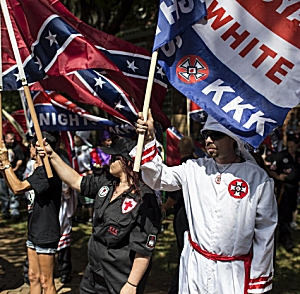 who are utterly opposed to blacks being treated as equal to whites. A second group would be fundamentalist Muslims who are violently opposed to women being treated as equal to men, mirrored of course by the Catholic Church who are also bitterly opposed to women having equality with men, followed by religious groups opposed to homosexuals having equal rights to heterosexuals. Then we have those that use their wealth and/or power to exclude the rest of us from their parties, events and golf courses, from Kim Kardashian to King Charles (who would expect you to bow in reverence if you did meet him, because ... again ... we're not equal). To reiterate, there are many groups worldwide in positions of power and privilege for whom the thought of equality is anathema, so yes, many such people are delighted that their group is not equal to other groups, since when groups are not equal that's seen as a positive if you happen to belong to the superior group.
 possibly maintain somewhat similar services to what are currently provided, but duplication of services seldom make economical sense. Think of every town having to fund two schools, one for Maori and one for non-Maori. Could the small Maori school hope to have the same fancy computers, sports equipment and science labs that the much larger non-Maori school could afford? Wouldn't this division merely create discontent and what would be seen as a privileged group? Currently everything Maori have demanded and got, like Rongoa Maori clinics (traditional Maori healing), Rangatahi Courts (Maori youth courts that follow NZ law but are held on marae and follow Maori cultural processes) and two Maori TV channels, have been funded by NZ taxpayers, but were true separation of services to happen, as many Maori desire, then clearly funding would cease. So would two systems work, would immersing Maori in their traditional culture recreate their lost past and improve their lives? Economically and logistically it would fail, and culturally, even if it were possible, we believe it would fail too, as most all Maori are (quite sensibly) very attached to the marvels, rights and freedoms found in 21st century Kiwi culture and, if properly informed, would quickly reject reverting to 14th or 18th century Maori culture. Life back then only seems like paradise when portrayed in movies like that Disney one about Moana and the god Maui ... I forget what it was called. But the reality is that Hollywood lies, a lot, there was no Maori utopia, Maui wasn't a real god and creating separate services for Maori has no hope of restoring that fantasy world.

 But finally society came to its senses, and mobs of angry torch-carrying villagers chased the arrogant Christian priests back to their churches and into the arms of their choir boys. Reason ruled the land, no longer was one group of (deluded) people dictating how everyone else should behave. But slowly and insidiously a new terror began to stalk the land. Where we once had worthless Christian prayers intruding on our lives we now have worthless Maori prayers, with ignorant Christian priests being replaced by the ignorant Maori equivalent. Instead of European Christians from the local church clutching their Bibles and being consulted and automatically granted positions on committees, we now have tattooed Maori elders from the local tribal marae clutching their bone carvings and being consulted and automatically granted positions on committees across the land, from central government to local government to telling Kiwis which parts of NZ's natural landscape can't be shown in movies. Where in the past people were greeted with a European handshake and the offer of a nice cup of tea, now we're "greeted" by half-naked warriors performing a menacing haka or an intimidating wero (a warrior challenge using a weapon). Even visiting royalty must endure this uncivilised greeting.
 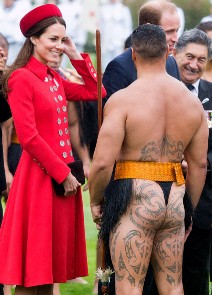 Christians (thankfully) no longer have the clout to influence public affairs, now that clout firmly belongs to Maori. They now sprinkle the magic holy water, offer prayers at sporting events, welcome foreign visitors dressed as primitive spear-waving warriors, bless new buildings and heli pads, and place a tapu (a spiritual prohibition) on accident sites and exploding volcanoes. Maori superstition has taken over the role vacated by Western superstition. Where we once feared angering the invisible Christian god, now we risk offending not just the invisible Maori gods, spirits, ancestors and taniwha (dangerous, and invisible, supernatural creatures), but also the easily riled Maori individuals delivering the prayers or performing the haka, who are often armed with traditional weapons. I remember an historical reenactment two or three decades ago of Captain Cook and his sailors coming ashore to be greeted by Maori, and one or two of the Maori playing the part of the "warriors" actually used their traditional weapons to physically assault the "British invaders". Maori were allowed real weapons, unlike the "British" whose muskets and swords were fake.
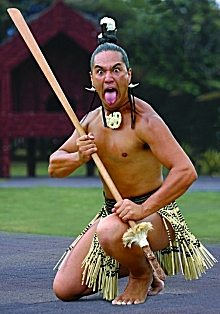
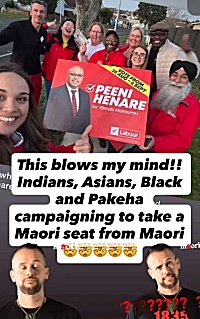 recently rose to infamy with this Internet post (right) concerning the Sep 6th, 2025 by-election to contest the Auckland Maori seat of Tamaki Makaurau. There were only two candidates standing, Oriini Kaipara from the Maori Party and Peeni Henare from the Labour Party. Both were Maori although as we've mentioned, even though it is a Maori electorate people of any ethnicity can stand. The photo shows some Labour Party volunteers (all apparently non-Maori) helping in their candidate's campaign. It says, 'This blows my mind!! Indians, Asians, Black and Pakeha campaigning to take a Maori seat from Maori'. The thing is that a person of Maori descent would be elected no matter who won (Kaipara did), but Ferris apparently believes (quite wrongly) that only Maori Party candidates should be able to win Maori electorate seats; not Maori from other political parties and certainly not non-Maori or anyone being helped by non-Maori. We're guessing that Ferris sees Maori that belong to other political parties as traitors to his racial cause (an 'Uncle Tom' to use the pejorative American term). The Labour Party saw the by-election as Maori and non-Maori working together whereas Maori Party MP Takuta Ferris saw it as Maori against non-Maori. Labour MP Willie Jackson (also a Maori) said 'of course' the post was racist. Anyway, onto that other quote from Takuta Ferris. He recently claimed in parliament that,
 And of course only Maori are eligible for these teams or awards. Reread that list and replace Maori with European (or better still, with the more meaningful word 'white'). No national teams, awards etc exist that exclude Maori and Maori certainly wouldn't stand by if someone tried to establish them. And nor should they. They could rightly scream racial discrimination if the All Blacks barred Maori from being on the team. Remember that New Zealanders of both European and Maori descent rightly condemned South Africa for having a national rugby team based on race, but then Maori continued to promote a race-based team of their own, the Maori All Blacks, or the New Zealand Natives as the team used to be called, where all players are required to have confirmed Maori ancestry. What fucking hypocrites, continuing the very abomination they criticised South Africa for. Likewise Maori could and would rightly scream racial discrimination if there were Caucasian Media Awards or European Business Awards for which they were prevented from competing in because of their race. And yet they see no problem with creating teams, awards and companies organised around racial discrimination. As long as you have some Maori ancestry, then you qualify, and ... obviously ... those of other ethnicities need not apply. When it comes to the likes of the Maori Literature Awards or the Maori Business Awards, non-Maori aren't just relegated to the back of the proverbial bus, they're not even allowed on the bus. Instead of all cultures and races integrating and becoming Kiwis, some Maori are doing their best to tear down what unity there is and create an 'us and them' division. When in government, a previous leader of the political Maori Party was forever saying that, 'I'm doing this for our people' ... 'I'm trying to ban smoking, cigarettes are killing our people' ... 'We need to reduce crime to help our people' etc. She never once suggested she wanted to help everyone or all NZers, everything she did was just for 'our people', ie just the brown ones. Of course she realised that cigarettes and crime harms everyone, not just Maori, but she didn't care about non-Maori. A protester supporting the treaty and condemning the bill, Tukukino Royal, said, 'Today is a show of kotahitanga — solidarity — and being one as a people, and [to] uphold our rights as Indigenous Maori'. But note how his talk of solidarity only extends to other Maori, not to Europeans, and being one as a people only refers to Maori remaining united, not to Maori and Europeans uniting as a single people, and how upholding our rights only applies to upholding Maori rights, and as such his sentiment contradicts everything his cherished treaty tried to accomplish. Several times this week alone we've heard Maori activists on radio and TV talk of 'our people' and 'our land', each emphasising those phrases to signal that as natives Maori have special privileges, coupled with the silent but clear implication that 'you people' shouldn't even be here in 'our land'. Again, imagine a political party for just white people whose white leader went on and on about 'our people'. A political party or group where a white skin ethnicity was needed to join would never succeed in NZ, and yet one based on brown skin ethnicity has flourished. We can't help but feel something is wrong here, that just because some non-Maori feel guilt over some historical injustices that would have included racism and oppression, then the country should now let Maori be racist and oppressive towards non-Maori in return, that there was a time when whites had privileges that Maori didn't, so now it's their turn to have privileges based on their race. Tit for tat. It's only fair. Right?
 (and unknown to us) example of racist history in the South Auckland town of Pukekohe during the 1950s and early '60s. It detailed shameful racial segregation reminiscent of what was common place in the US at that time (thankfully there were no lynchings here). We were surprised and embarrassed that this had occurred in NZ relatively recently, around our parents' time. We had long assumed that historically some people in NZ would have been quite racist, after all our colonial immigrants came from the same place and culture as those that went to America, and look how racist many of them were (and still are), but to think that this had happened in NZ in the mid-20th century, not the 18th or 19th, was quite shocking. But a second thing that shocked me was how the documentary actually exposed two groups of racists (no doubt unintentionally and likely not noticed by most), one group obviously being the white European racists from the 1950s, but also a second group, the Maori racists from 2022. This revealed the reality that racism is not about white supremacy per se, not about discrimination against anyone who isn't white (or as the Americans say, anyone who isn't a WASP — a White, Anglo-Saxon Protestant), racism is simply discrimination against anyone who has a different ethnicity or skin colour to you. Even a difference in culture can create a version of racism. I remember my Chinese friends in Hong Kong telling me that some Chinese call Chinese people that have lived or grown up in Western countries like the US and Canada 'bananas', a 'racial' insult meaning that they may still look yellow but they are now white on the inside. Racism is often taken to mean white supremacy, but people of any colour can be racist. I was well aware of this but was still surprised at how racist some of the elderly Maori (mostly women from memory) came across in their interviews in the documentary, individuals that had experienced racial abuse from Europeans when they were young. Even though the racist treatment they suffered as kids no longer happens (they certainly didn't mention any recent incidents), some clearly still felt burning hatred towards Europeans, any and all Europeans. And to us that is racist. Hating a specific someone who physically mistreated you when you were a kid or youth is understandable, but hating all Europeans today who don't mistreat you simply because some long dead European mistreated you 70 years ago is pure racism; hating innocent strangers based solely on their ethnicity and skin colour. Some of these elderly Maori were even angered by Bartholomew (someone with a Caucasian appearance) for daring to reveal how racist some attitudes towards Maori were back then, saying that a white person had no right to tell their story, a story that belonged to Maori. Of course since it takes two to create an abuse story, the abuser and the abused, Maori would technically only own half the story. But we agreed with Bartholomew when he said that no one owns history, and he has just as much right to tell the story as anyone, especially since many of those angry Maori said they never wanted to talk about what happened, they never wanted the story told. Clearly they were still very angry about their treatment, and rightly so, but rather than just let it fester until they die, why wouldn't they want the world to know about the injustices they suffered? If people, like myself, say there was no racism where they grew up, and some Maori know different, why wouldn't they want to set the story straight, rather than just fuming under their breath when Europeans say Maori had it pretty good back then? One person even questioned Bartholomew's ability to come here and talk about racism since he is an American and we all know America is the most racist country on the planet he said, his clear belief being that all white Americans are obviously racists and will clearly be biased. (And while from the US, Bartholomew actually now lives and works in NZ.) Of course that quite bogus belief is utterly racist in itself, assuming what beliefs someone must hold based on their skin colour. So by looking at Pukekohe the documentary revealed (against the wishes of many) that there were of course some shameful cases of racism in NZ's past, but by not mentioning any other similar racist communities and by not saying that what happened in Pukekohe was typical for the time, it wouldn't be unreasonable to infer that this level of racism was atypical in NZ in our relatively recent past, and both Maori and Europeans living in Pukekohe today conveyed that such racism and segregation doesn't exist today.
 done since it was written centuries ago. But this is utter bullshit. If you read the US Constitution you'll see that, for example, it allows slavery and denies women the right to vote, and these are just two examples of laws that are now completely reversed in 21st century America. But how can radical changes have been made to this historical legal document that can't be changed? And it can't be changed because Americans believe that legislators back in the 1700s created the perfect legal document, good for any and every era. You don't mess with perfection, especially since God approved of it. But the reality is that, not only did God not approve it, the 'unchangeable' US Constitution has been modified 27 times — these changes are called amendments — the last in 1992, with 6 more waiting to be ratified, all to account for situations the original 18th century authors hadn't thought of. Far from seeing themselves or their newly drafted legal document as perfect, the framers of the Constitution even included a provision to allow for such amendments. They knew they were writing a legal document for their era, not one that must remain unchanged for all time, and that in the future there would surely be a need to correct omissions or oversights in the original Constitution. And they were proved right, that no first draft of any law stands for all time, that future tweaks or complete rewrites will almost certainly be required. Another famous historical legal document would be the British Magna Carta of 1215 CE, but again its laws have been radically modified. It was an excellent start in advocating for equal rights, but has required untold improvements over the intervening centuries to provide rights to everyone, not just the ones around at the time making the new laws, ie the elite.